[완료] 11월 8일 Rettungsdienstkongress 2026 온라인 초청강연
비회원
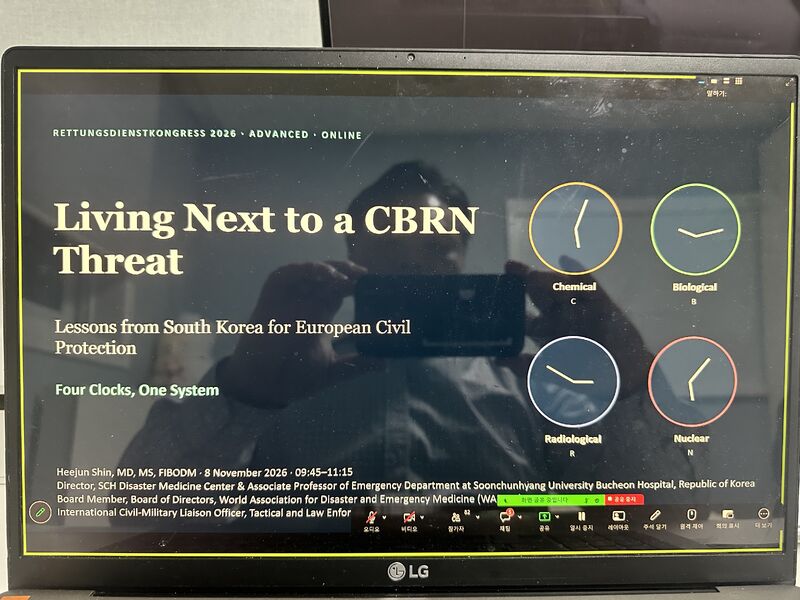
신희준 SCH 재난의학센터장이 11월 8일 RDK 2026 온라인 초청강연과 질의응답을 마쳤습니다. 한국의 CBRN 대비 경험과 기관 간 협력을 다뤘으며, 발표자 본인 후기와 강연 화면 사진을 함께 전합니다.
한국의 CBRN 대비 경험을 유럽 응급의료·시민보호와 나누다
활동 상태: 온라인 초청강연·질의응답 완료 · 행사일: 2026년 11월 8일
신희준 SCH 재난의학센터장이 2026년 11월 8일 독일 Rettungsdienstkongress 2026에서 온라인 초청강연과 질의응답을 마쳤습니다. 강연 제목은 “Living Next to a CBRN Threat: Lessons from South Korea for European Civil Protection”입니다.[1] 공식 프로그램에는 영어로 진행되는 Advanced 세션으로 편성됐습니다.[2]
강연에서는 화학·생물학·방사선·핵 위협을 뜻하는 CBRN에 대비할 때 구급 현장, 병원, 공공보건과 시민보호 체계를 어떻게 연결할지 다뤘습니다. 구미 불산 누출, 메르스와 코로나19 등 한국의 경험을 바탕으로, 위협마다 대응의 시간적 특성은 달라도 여러 기관이 같은 대응체계 안에서 함께 움직여야 한다는 점을 설명했습니다.[1]
발표의 중심은 개별 기관이 보유한 장비나 전문인력만이 아니라, 기관 사이의 판단·협력·정보 인계가 실제 준비태세를 좌우한다는 데 있었습니다. 한국의 체계를 그대로 옮기는 대신, 한국과 독일의 제도 차이를 고려하면서 각 현장에 적용할 수 있는 원칙을 찾자는 취지입니다.[1]
질의응답에서는 오염·감염 가능성이 있는 환자를 돌보는 의료진의 두려움, 대응자의 안전과 진료 책임의 균형, 구급대원을 위한 체계적인 중독학 교육, 대비훈련을 지속할 재원 확보가 논의됐습니다. 기술뿐 아니라 교육과 조직 운영을 함께 다뤄야 한다는 문제의식을 나눈 자리였습니다.[1]
출처
Heejun Shin. Rettungsdienstkongress 2026 강연·질의응답 후기. 본문 기재일: 2026년 11월 8일.Rettungsdienstkongress. 2026 공식 강연 프로그램.
2026년 11월 8일 RDK 온라인 강연의 제목 슬라이드가 표시된 화면. 사진 출처: 신희준 센터장 본인 게시물.The title slide displayed during the RDK online lecture, 8 November 2026. Photo: Heejun Shin’s own post.
RDK 2026: connecting Korean CBRN experience with European preparedness
Status: invited online lecture and Q&A completed · Date: 8 November 2026
SCH Disaster Medicine Center Director Heejun Shin delivered an invited online lecture at Germany’s Rettungsdienstkongress 2026 and took part in the subsequent Q&A.[1] The official programme listed the lecture as an Advanced session delivered in English.[2]
Drawing on Korean experiences, including the Gumi hydrofluoric acid release, MERS and COVID-19, Shin discussed how chemical, biological, radiological and nuclear (CBRN) hazards create different response timelines within a shared emergency system. His emphasis was on the decisions, coordination and handoffs that connect emergency medical services, hospitals, public health and civil protection—not simply the capabilities held by any one organization.[1]
The discussion considered healthcare workers’ fear of caring for potentially contaminated or infectious patients, the balance between responder safety and the duty to care, structured toxicology education for emergency medical services personnel, and sustained funding for preparedness exercises. The aim was to identify useful operational principles while recognizing the differences between Korean and German systems, rather than to recommend copying one country’s model.[1]
Sources
Heejun Shin. Report on the RDK 2026 lecture and Q&A. Date stated in the post: 8 November 2026.Rettungsdienstkongress. 2026 lecture programme.
/weven_data/user_site/mschdisasterp4l/ai_import/88ad384364cc701bd1f0.jpg
german-keynote-2026,initial-german-keynote-2026,국제교육,RDK2026,완료