[EN] The phone number that belongs beside the emergency bag | 2026-11-11
관리자
SCH Disaster Medicine Center — Analysis
2026-11-11 · EN · SCH-COLUMN-2026-11-11 · HOUSEHOLD-CONTACT
What people hear when they are told to pack a bag
Tell people to set aside water for an emergency and some will check what they have at home. Others will first ask whether the water is about to be cut off. Both have taken the message seriously. If the authority responds to the second question by sending the shopping list again, advice about something to do in ordinary times may sound like an instruction to go out and buy water now. Two recent statements from Brazil illustrate how household preparedness begins with understanding what people will hear, even before anyone buys supplies.
On 7 November, local time, Brazil’s Ministry of Integration and Regional Development explained that national civil defence advice to assemble an emergency kit was a routine precaution. It was unrelated to a nationwide alert or a forecast of widespread supply interruptions. The ministry also described how actual warnings are delivered.[1] On 10 November the city of Cuiabá explained the advice to its residents and gave them a way to contact municipal civil defence.[2] The two statements trace a national clarification into a local community. They tell us little about how anxious residents were or whether they bought more or less water afterwards.
The K72 app introduced in Montijo, Portugal, starts with a different question. Once families are asked to prepare, who helps them do the work? The developers listed 5 November as the launch date. The app helps families organise emergency supplies and a household plan on their phones.[3] On 10 November Euronews reported on the tool, developed in collaboration with local civil protection.[4] That was the date of the news report. It signalled neither a Portuguese emergency declaration nor the publication of an evaluation showing that the app had reduced harm. The question linking Brazil’s clarification with the Portuguese initiative is what residents can actually do after they read an announcement.
Among the Korean material reviewed, we found no new national measure on this particular subject announced on 11 November. A recent domestic example comes from the National Fire Agency, which announced its 79th fire prevention month on 4 November. The campaign runs from 1 to 30 November and includes planning how to escape a fire at home.[5] Taking time to collect belongings in a burning home is a different matter from organising essentials and contact details in advance. Adding a time horizon borrowed from another country to Korean fire instructions could obscure what those instructions ask people to do.
What comes into focus across these accounts is the household in which the bag will sit. The person who can find it may not be the person who has to carry it. The family member who saved the plan on a phone may be miles away at work during the day. Before asking how many things people own, it is worth asking whether those who will use the plan know what it says. A survey of what Europeans said they and their households had done offers a way to examine that distinction.

A torch within reach, an agreement about how to call
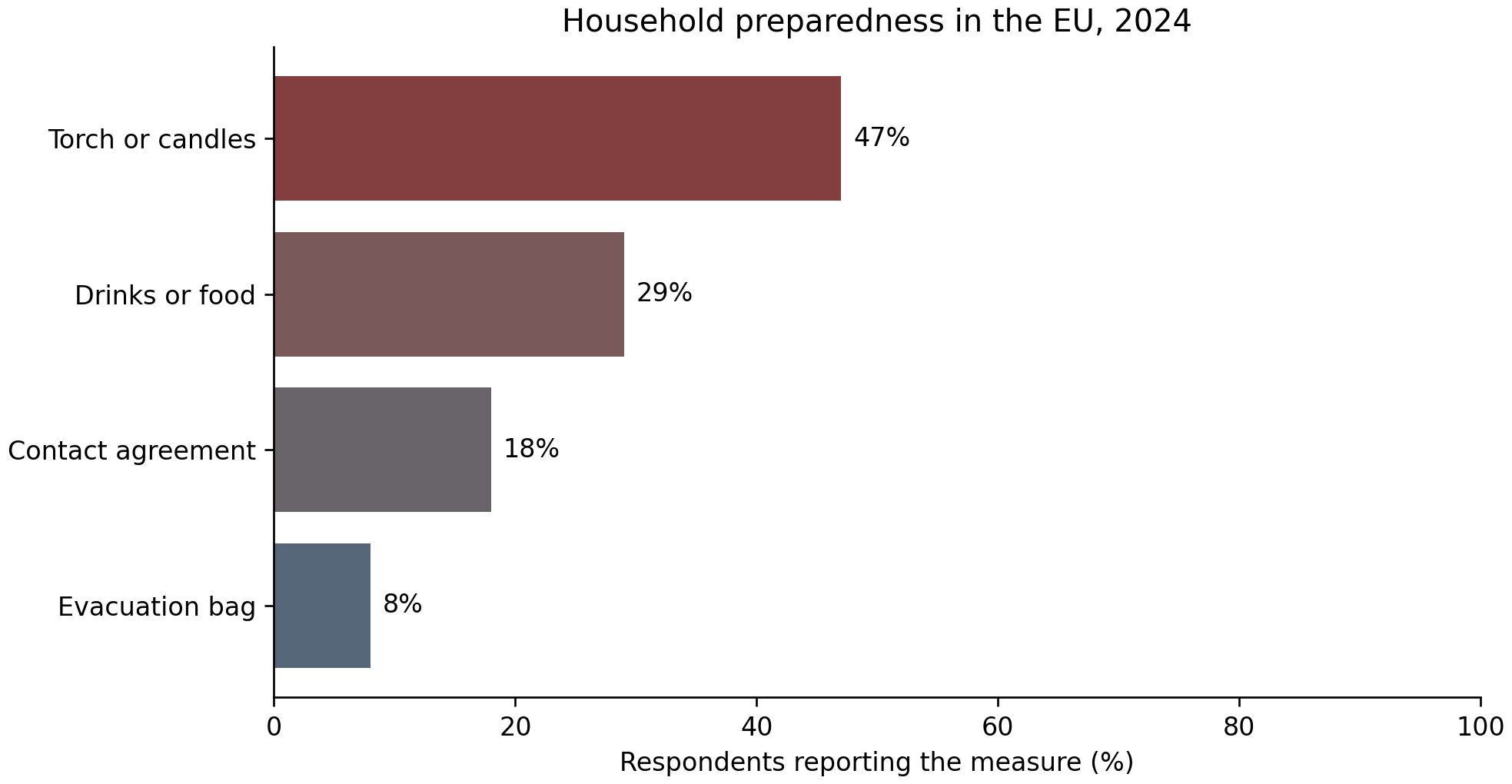
Fieldwork for the European Commission’s Special Eurobarometer 547 ran from 7 February to 3 March 2024. The survey covered EU citizens aged 15 and older living in member states. Respondents across the 27 EU member states were asked which measures they or their household already had in place for a disaster or emergency. They could select multiple answers to this question, QC6.[6] The Union Civil Protection Knowledge Network published an account of the main findings, including figures on supplies.[7] The two publications provide a check on the figures from a single survey. They do not constitute two independent surveys. We selected four things families can do in ordinary times and plotted them on one scale.
An accessible torch or candles was reported by 47% of respondents. An emergency stock of drinks or food was reported by 29%, an agreement with relatives or friends about how to get in touch by 18%, and a bag ready for rapid evacuation by 8%. All four percentages use the same respondent base for this question. One person reported on the household. Neither individual possessions nor household members were counted. The first figure cannot be restated as the share who owned both a torch and candles. Nor did the food question involve an inspector visiting each home to check the quantity and condition of its supplies.[6]
The gap between the highest and lowest of the four figures was 39 percentage points, calculated by subtracting 8 from 47. The gap between stocking food or drinks and agreeing how to make contact was 11 points. These figures can be misleading if pictured as a hundred people progressing through successive stages. We do not know whether everyone who had packed a bag had stored food or everyone with a contact plan also had a torch. People could appear under more than one heading. Adding the four bars cannot produce a preparedness score for a community.
| Measure | % |
|---|---|
| Torch or candles | 47 |
| Drinks or food | 29 |
| Contact agreement | 18 |
| Evacuation bag | 8 |
The comparison is still informative. It is easy to write a question about an object in a home. An agreement between two people who may be apart is harder to complete alone. Even within one survey, the two kinds of question elicit different responses. An agency that asks only about torches will learn little about which households lack a contact arrangement. The practical lesson is that information is lost when one measure is allowed to stand in for another.
Several explanations remain possible. A respondent may know exactly where an everyday torch is kept yet speak with family so regularly that the household has never thought of its arrangement as an emergency plan. A family that keeps things in several convenient places might have useful supplies and truthfully report that it has no packed bag. Conversely, a household that reports a bag may have a child who has grown or an assistive device that has changed since it was last checked. Four population percentages cannot establish which explanation fits the largest number of homes.
The choice of items can also change the impression. The same source table reports that 20% kept emergency water for cooking and hygiene and 20% had a battery-powered radio within reach.[6] A comparison restricted to two of our four items might suggest that supplies are generally available and only communication is neglected. The water and radio figures reveal substantial differences among supplies themselves. That is why it matters to explain the selection and mention examples left out. The four items do not summarise the entire questionnaire in a single score.
There is no reason to expect identical figures in a Korean community. Housing type and size, where people spend their days and nights, and the way authorities issue warnings can all change what a question means. These EU-wide aggregates offer no breakdown here by living arrangement or need for assistance. They cannot yield a count of vulnerable Korean households or a figure for additional ambulances. A first step towards a local comparison would be to translate the questions and invite residents to explain each in their own words. The interviewer and respondent need to be thinking about the same kind of preparation.
What needs to accompany a three-day planning horizon
The 72 hours in the Portuguese app give families a period over which to think about the first days of disruption. A time horizon can be more helpful than a vague “someday” when deciding what a household might use. It specifies neither how long all medicines can be stored nor how long a patient can safely wait. For someone who depends on breathing equipment or attends treatment at set times, preparation involves more than putting spare supplies in a bag. The plan also needs a way to reach someone who can hear the circumstances and discuss what to do next.
Consider a hypothetical family. Over the weekend they organise water and shelf-stable food and put a relative’s telephone number beside the fridge. One member works away from home on weekdays. The mother who stays at home has difficulty reading small print. Asked whether a contact number is available, the family can truthfully answer yes. Whether the person who needs the number can read it is a separate question. Next time they are together, the mother might choose a location and print size that suit her, then try reading the number herself.
Even for this one family, leaving home differs from remaining there. Water stored at home can be useful during an interruption, but carrying all of it downstairs may be impractical. When family members have to find one another outside, an agreed meeting place and an order for making calls may matter more than water at that moment. Rather than simply urging residents to acquire more, an agency can give them an opportunity to decide where supplies for home use should go and who could carry essentials on the way out. When danger is imminent, evacuation instructions must come first so people do not return for possessions.
Disaster medicine meets ordinary care in differences of this kind. Hospital advice should never leave someone with an urgent problem thinking that the bag must be complete before help can be sought. A request for additional medication also differs from a request for help identifying an existing prescription. Clinicians can explain options in light of the individual’s condition and prescription. Local agencies can clarify where questions can go when the usual office is closed. Agreeing these roles in advance may spare people the burden of retelling their story from scratch at every desk. This is a proposal for Korean services. Its effectiveness was not measured in the overseas announcements.
Between receiving supplies and trying them out
One study of preparedness education examined a peer-mentored programme led by Eisenman and colleagues. Adults living independently in the community were randomly assigned to receive the programme or join a waiting-list control group. A health educator and peer mentors taught four two-hour classes together. According to the published abstract, the evaluation covered 82 adults and assessed preparedness supplies and earthquake safety knowledge before the intervention and one month afterwards.[8] The important difference from a contemporary app is less the age of the study than the repeated opportunities to work with another person.
In the intervention group, the share of preparedness items completed increased from 56% to 75%, and correct answers to knowledge questions rose from 79% to 87%.[8] The 19-percentage-point difference in the first measure is a before-and-after change within that group. Calling it a 19-point advantage over the waiting-list group would change the comparison. Nor does a better score a month after teaching establish that fewer people were injured in an earthquake years later. The evidence used here extends to the actions and knowledge assessed and the time at which researchers assessed them.
The result does not prescribe importing the programme intact. People able to attend four sessions may differ from other residents, and those unable to participate may need another approach. It does, however, give reason to question the assumption that everyone who receives a leaflet can do the same things with it. Finding supplies with someone and having another opportunity to practise the following week differ from reading a leaflet once. A small Korean pilot could begin by deciding how it would observe that difference.
Suppose two areas receive the same advice and one offers brief practice with a peer on request. Even if participating households in that area do better a month later, residents familiar with community organisations may have been more likely to sign up. Assessing the contribution of peer support would require attention to starting conditions, routes into the programme and households lost to follow-up. Where that is impractical, a service can report how many sessions it held and which barriers it uncovered. A narrower, honest account can still inform the next round of work.
Start with a day in the life of the person who needs the plan
Imagine a discharge conversation with a fictional patient. A caregiver has the schedule on a phone. Once home, the patient will spend several hours alone. Asked whom they would call if the power went out and communications slowed, the caregiver can name the usual hospital. It remains unclear whether the patient can find the number on paper, or whether the first person answering can distinguish a routine scheduling question from an immediate need for help. The conversation might include letting the patient choose which paper they would reach for, in addition to writing down the number.
What belongs on a single sheet depends on who will read it. A copy for the patient at home may need familiar words and large print. A sheet to show an ambulance crew might briefly describe equipment in regular use, the patient’s usual way of communicating and the assistance required. A list posted publicly at a shelter has no need for individual diagnoses or detailed addresses. Every extra document taken outside adds to the consequences of loss. Patient and staff can agree what to include and with whom the patient wants to share it.
In a Korean apartment building, deciding where to put the bag still leaves the journey itself to plan. Beyond the front door lie shared corridors and stairs. A person who routinely uses a lift cannot assess another route entirely from inside the flat. Residents need not simulate a hazardous situation. In ordinary conditions the building manager and residents could check accessible routes, identify where someone can ask for help and decide who will receive the request. Checking whether the person expected to assist is also available at night exposes a specific gap that a written promise may conceal.
Insisting on a relative’s number would exclude some people who live alone, have family far away or no longer have contact with relatives. They should be able to choose a trusted and willing alternative, such as a neighbour or community service. Conversely, a relative who lives nearby may still be unavailable on a weekday afternoon. A simple exercise can establish who takes over if one person does not answer and whether everyone is calling the same person repeatedly. The purpose of writing this down is to find a workable route to help, without passing judgment on family relationships.
For a household that uses another language, the easiest response may be a translated list of supplies. Being able to read the list and knowing where to go when a warning arrives are distinct achievements. An organiser could offer a small map and ask a resident to describe the route from home to the meeting place. That may reveal confusion caused by a single term. If the encounter feels like a test designed to identify wrong answers, people may hesitate to admit uncertainty. Asking residents to help locate and correct unclear wording creates a better opportunity for feedback.
The services receiving calls need a plan too
A discussion of household plans can quietly push hospitals and ambulance services to the end of the sentence. The longer the list of things residents should do, the less visible the questions that services must be willing to receive. A hospital that publishes a contact number needs to decide what the person answering can handle, who takes over unresolved matters and what to tell callers when another office is closed. The appearance of a telephone number in a leaflet is insufficient evidence that it can bridge an interruption in care.
A hypothetical tabletop exercise might give a local public health office, hospital and ambulance service the same enquiry in turn. The resident opens by saying the road to a scheduled treatment is blocked. Record where each agency directs the resident and what the next agency knows about the conversation so far. If the resident must repeat everything three times, the missing element may be an agreement about what staff should pass on, not a piece of paper in the resident’s bag. Fictional details allow services to test the route before involving patients.
Exercise designers should distinguish dispatch requests from questions about daily needs. Someone seeking an alternative route past a flooded road and someone needing immediate medical attention may start a call in similar words. Rather than handing residents a long list and expecting them to classify themselves, the receiving agency needs to recognise urgency and connect callers with appropriate help. Decisions about an individual’s treatment or transport belong with professionals assessing the situation. Percentages from a household survey have no place as dispatch or transport thresholds.
At a shelter, the family carrying a bag may look better prepared. But someone who arrived empty-handed because they left promptly may have made exactly the right choice. Asking what help someone needs tonight before inventorying what they brought can change the priorities at reception. Staff can distinguish a person who has familiar belongings but cannot use them from someone who brought nothing and currently needs no additional assistance. Support should follow the need that emerges from that conversation.
The journey home also leaves work for clinical and community services. People may need to return borrowed items, replace missing documents before an appointment or establish when a usual caregiver can visit again. Questions still unresolved at this stage can inform the next exercise. A record can show which function was interrupted, when it failed and which contact resolved it without retaining someone’s name. To connect recovery with future preparedness, services need to see the sequence of these small disruptions as well as estimates of financial loss.
Choosing an evaluation that a community can actually carry out
Suppose a Korean district revises its advice to households. In the first month it can count leaflets distributed and homes reached. Combining those measures could turn several visits to one address into apparent contact with several households. With residents’ agreement, the programme can distinguish repeat contacts and record attendance at group events separately. Identifying every resident from the outset is unnecessary. The information needed depends on whether the question concerns households reached or printed material used.
Residents could then choose one task through which to check their preparation. For a household that has agreed on a contact, ask whether another family member can find the details. For one that has packed a bag, ask whether the person likely to leave in a hurry can carry it and whether the family knows where it is kept. The relevant denominator is the households that chose that task and agreed to follow-up. Record those who do not reply separately. Counting only reachable households may overstate success, while treating every non-response as a failed task obscures what is unknown.
Three lines can communicate the result more clearly than a single score. Give the number of households that joined, the number reached again and the number among those reached whose task was confirmed. Dividing the last by the second describes the result among those followed up. Dividing it by the first shows the share of everyone enrolled for whom completion was confirmed. When the values differ, finding where contact was lost is more useful for the next round than presenting only the more favourable figure.
Cost also shapes participation. A programme built around buying the same bag may first reach households able to afford it. Allowing people to start by locating things in everyday use or agreeing with a neighbour on the order of calls gives households with little spending room a way to participate. Practice alone, however, cannot supply a missing essential. Before repeating the advice, organisers can ask whether the barrier is the item itself, delivery, storage space or help with mobility, then connect the household with available support. Showing those distinctions in a budget allows the cost of supplies and the time required for visits to be considered together.
Timing affects evaluation as well. Asked on the day of a session, residents can readily recall what they have just heard. Several weeks later they may report losing the leaflet or finding no occasion when the family could meet. The later answer is not necessarily more accurate. An actual warning or training from another agency may have intervened. Recording the dates of advice and follow-up and asking one question about what happened between them preserves circumstances that a simple comparison of two scores would miss.
There are limits to testing a task in practice. A resident can find a sheet and read a number aloud, but placing a test call to emergency services or unplugging essential medical equipment can affect people’s safety. Agencies should clearly distinguish exercise contacts from actual assistance and select tasks that leave working medical equipment alone. Separately recording what residents demonstrated and what they could only describe improves the accuracy of the evaluation without creating a hazard.
One average can conceal important differences in housing. Imagine two households receiving the same leaflet. One has space by the front door. In the other, a bag in a narrow passage would make movement harder. If the second family chooses a small pouch for frequently needed items, it might score poorly on a checklist built around a large bag. The problem it actually solved was keeping a passage clear. Recording why people chose their task makes it possible to explain a result when it differs from what the checklist designer had in mind.
Organisers can also choose how to retain comments. Sharing long, unedited responses can expose identifying details about a home or family. A staff member might instead record the wording that caused confusion and the change that helped, then ask the resident whether the note captures their meaning. A complaint about small print would remain open until the person had tried reading the enlarged text. Such a record is more specific than an anecdote collected to showcase success. A colleague taking over can see who checked the change and which questions still await an answer.
Some outcomes can only be assessed after a disaster. Someone who found an item during practice may leave it behind in an actual evacuation to help a family member. Judging that decision requires knowledge of the danger and the instructions at the time. Turning an exercise score into a verdict on real conduct makes it too easy to blame people after the fact for decisions made under pressure. Evaluation should help change the conditions in which residents will make the next decision.
Finally, does the revised notice answer the resident’s question? Routine advice can explain why it is being issued now, where people can check for an active local warning and what small task one household could finish today. When a warning is active, the location, timing and action requested should lead. Brazil’s clarification explained the purpose of ordinary preparedness advice. Montijo’s tool offers a way to translate such advice into household work. What will work in Korea requires hearing what residents understand and what happens when they try to act on it.
If one person can open a drawer and find what they need and another can say where they will meet again, that day’s practice has achieved something specific. If either task proves difficult, the family can move the paper or change the agreement and try again. Hospitals and local agencies can do much the same. They can test whether a call goes where they tell people it will go and trace one enquiry that never reached a person able to resolve it. A question about an emergency bag ultimately leads to a question about care. On the day of disruption, can the person who needs help actually reach it?
References
- [1] Ministério da Integração e do Desenvolvimento Regional. MIDR esclarece que kit de emergência é medida preventiva e não tem relação com alerta nacional. 7 Nov 2026.
- [2] Prefeitura de Cuiabá. Defesa Civil de Cuiabá esclarece informações sobre kit de emergência e alerta para fake news. 10 Nov 2026.
- [3] K72+. A tua mala e o teu plano no telemóvel. 2026.
- [4] Ricardo Figueira. New K72 app helps Portuguese prepare 72-hour emergency kits for disasters. Euronews. 10 Nov 2026.
- [5] 소방청. 제79회 ‘불조심 강조의 달’ 운영, 국민과 함께 겨울철 화재예방 나선다. 2026-11-04.
- [6] European Commission. Special Eurobarometer 547. Risk awareness and preparedness of the population. 2024. QC6 and Technical Specifications. DOI 10.2795/1333368.
- [7] Union Civil Protection Knowledge Network. Newsletter 13, October 2024. Special Eurobarometer on disaster preparedness.
- [8] Eisenman DP, Bazzano A, Koniak-Griffin D, et al. Peer-mentored preparedness (PM-Prep): a new disaster preparedness program for adults living independently in the community. Intellect Dev Disabil. 2014;52:49–59. doi:10.1352/1934-9556-52.1.49. PMID 24635691.
Brazil’s clarification about emergency kits and a Portuguese family planning app raise a practical question. Can the person who needs help find the supplies, reach someone and continue care?
SCH-COLUMN-2026-11-11,EN,HOUSEHOLD-CONTACT