[EN] After the water tanker arrives, which services can a hospital sustain? | 2026-11-12
관리자
SCH Disaster Medicine Center — Analysis
2026-11-12 · EN · SCH-COLUMN-2026-11-12 · CLINIC-WATER
What it takes to keep a clinic open
When a health facility says that water is available, what care can a patient expect? There may be water for a patient to drink at reception. There may also be water suitable for preparing instruments in time for the next operation. Even inside the same building, the answers can differ. In a report from Solomon Islands on 12 November, the World Health Organization described health workers assessing whether their own clinics could stay open in an emergency. Babies are still born after a flood, and people with chronic conditions still need their medicines. A building left standing tells us little by itself about the care available that day. [1]
The training in Guadalcanal took place before the announcement, from 2 to 6 November. The Solomon Islands Ministry of Health and Medical Services led it with support from WHO and other partners. The release reports that 42 health workers received training. Participants identified communities and clinics exposed to floods, cyclones and landslides and practised responding to simulated emergencies. What matters here is the connection between identifying risks in a community and making a plan that its facilities can carry out. The number trained is known. The release contains no follow-up showing which services continued during a subsequent disaster or for how long. [1]
In Korea, a heavy-snow exercise took place on 11 November near the Chiak service area on the Jungang Expressway in Wonju, Gangwon. The Ministry of the Interior and Safety released its account on 12 November. A Newsis photojournalist also documented the exercise in Wonju on the 11th. A multi-vehicle collision and stranded vehicles were among the simulated conditions. The presence of recovery vehicles tells us nothing about actual crash numbers or patient transport times. For a hospital, the exercise does suggest a question about who depends on the road. The people delivering supplies travel on the same roads as patients and ambulance crews. [2][3]
In Nepal, the AIDS Healthcare Foundation, which took part in the response, published a retrospective account on 10 November. It concerned the floods of 26 August. Damaged roads and bridges made it difficult for residents to collect HIV medicines where they usually obtained them. The account documents access problems encountered by the organisation and its partners. It cannot establish the extent of treatment interruption across Nepal. The Korean exercise, the Solomon Islands training and the recovery experience in Nepal were separate events. Each invites a question about which services are affected first when people lose a familiar route or a facility loses the water it ordinarily uses. [4]
Consider a clinic in Solomon Islands. Within a health facility, it is something patients drink and something staff use to clean instruments and prepare a space for the next patient. A sign at the entrance saying that the facility is open conveys little of that distinction. Three different pieces of information are needed: what the facility ordinarily had, what it can still do on a day when restrictions apply, and where a person who has been kept waiting can complete a course of care. National estimates for Solomon Islands address the first question. The others require following the steps a patient takes.

What the estimates show inside and outside hospitals
The WHO/UNICEF Joint Monitoring Programme uses common definitions to compare water and hygiene services in health facilities across countries. We extracted the 2023 Solomon Islands entries from the water annex of its 2024 report. We read the entries for all facilities, hospitals and non-hospitals separately, transcribed the percentages classified as having basic, limited or no service in their published order, and calculated differences within the same category. The unit is a health facility. The denominator counts neither inpatients nor installed taps nor participants in the recent training. [5]
A basic water service means that an improved source, a type of source designed to protect water from contamination, is on the premises and water is available from it. A nearby improved source off the premises, or an improved source from which water was unavailable at the time of observation, can qualify as limited service. An improved source more than 500 metres away counts as no service. Unprotected sources, surface water or the absence of a source also fall into this category. Reading “no service” as meaning that no water whatsoever could be obtained would misdescribe the circumstances of some facilities. [5]
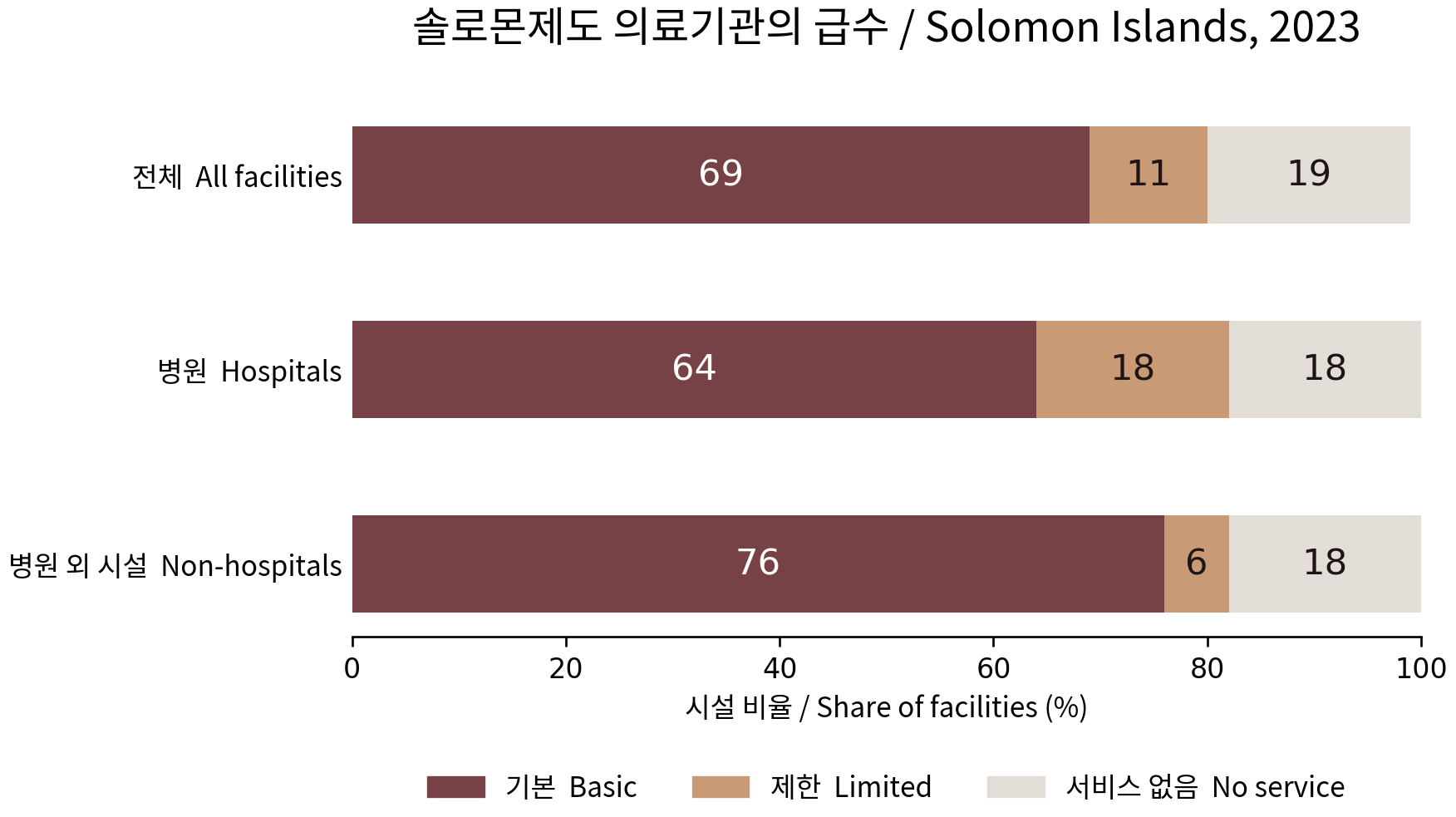
Among health facilities in Solomon Islands in 2023, 69% had basic service, 11% limited service and 19% no service. The printed values add to 99%. The source rounds to whole percentages. We have neither assigned the remaining percentage point to an invented “unknown” category nor stretched the bars to make them add up to 100%. Recovering the exact number of facilities in each category would require the original denominator and unrounded values. A small clinic and a busy facility can each be represented in a facility measure while accounting for very different numbers of patients. [5]
Among hospitals, the published estimates were 64% basic, 18% limited and 18% no service. Among non-hospitals, they were 76%, 6% and 18%, respectively. The reported share with basic service was 12 percentage points higher in non-hospitals. The displayed no-service share, however, was 18% in both groups. The difference lies mainly in the distribution between basic and limited service. These figures challenge the assumption that smaller facilities invariably have poorer water access than hospitals. They give no indication that a non-hospital could sustain surgery or dialysis longer in an emergency. [5]
| Facility group | Basic (%) | Limited (%) | None (%) |
|---|---|---|---|
| All facilities | 69 | 11 | 19 |
| Hospitals | 64 | 18 | 18 |
| Non-hospitals | 76 | 6 | 18 |
The overall percentage also needs careful reading. Adding 64 and 76 and dividing by two would give the groups equal weight without evidence of equal numbers of facilities. Such an average cannot replace the official total. Nor can the exact number of hospitals be recovered from the overall and subgroup percentages. The published values are rounded and the row contains no facility-level observations. Each bar in the figure therefore uses its own group as the denominator. We did not treat all facilities and the two constituent groups as three independent samples for a significance test.
For similar reasons, the 2023 estimate is unsuitable as a baseline score for the 2026 Guadalcanal course. It covers facilities across a country and cannot be linked to the people who attended or their workplaces. Water available on site at the time of observation does not tell us how long the supply lasted during the wettest week of that year. The figures do not show whether a maternity room and an outpatient reception area in the same building encountered different constraints. One productive use of the estimates is to select questions worth asking after training. [1][5]
Separating the conditions that distinguish basic from limited service shows why facilities in the same category may need different investments. Where staff fetch water from a nearby source, the time and effort spent carrying it matter. Where an on-site source frequently runs dry, the timing and duration of interruptions may matter more. In neither case does knowing the type of source establish that the water meets a particular cleaning requirement. Since the published figures do not distinguish these circumstances in enough detail to rank them by frequency, they point to different questions to ask on a visit.
What stopped while the emergency department was open
An investigation in West Virginia offers a way to move from the facility to the service. After a chemical spill affected the drinking water supply in January 2014, Hsu and colleagues surveyed operations at ten hospitals in the area. All six hospitals placed under a do-not-use order reported that they could no longer offer non-emergency surgery or endoscopy because instruments could not be sterilised. For emergency procedures they obtained sterilisation services from unaffected hospitals in the area. Some care stopped while other care continued with the help of a neighbour's equipment. [6]
There is a difference between a dry tap and a running tap whose water cannot be used. The hospitals faced the latter problem. Bringing in bottled water can meet drinking needs without making instruments ready for reuse. Even if another hospital can sterilise the instruments, transport is needed in both directions, along with arrangements for storage until the next procedure. A mutual-aid agreement between hospitals should therefore consider more than the quantity of water they could share. It can also identify which steps of a process normally completed under one roof a partner could take over.
All ten hospitals responded, but the survey did not cover independent dialysis centres or outpatient clinics unaffiliated with hospitals. Some responses relied on staff recollection and the investigators could not independently verify them all. The study was not designed to assess long-term patient outcomes. It cannot tell us how many lives mutual aid saved or predict the proportion of procedures that would be cancelled in another country. It does identify particular services dependent on water and illustrates whose experience can be missed by surveying hospitals alone. [6]
Eight of the ten responding emergency departments reported more visits after the spill. The denominator here is departments reporting an increase. It says nothing about eight in ten patients falling ill because of contaminated water, or about the reason for any individual's visit. People may seek emergency care when their usual service closes or when they cannot obtain advice about a perceived risk. The investigation cannot assign proportions to those possible pathways. That uncertainty is itself a reason to examine access to advice alongside access to clinical assessment. [6]
Count the tasks before counting the water
The US Centers for Disease Control and Prevention and the American Water Works Association advise healthcare facilities to identify how they use water, assess alternatives and exercise the plan. Uses extend from drinking and handwashing to preparing meals, laundering linens, reprocessing equipment and cooling. The guide supports planning. It provides no experimental finding that a single volume of water would make every hospital safe. A facility can start by taking its departmental water-use records and mapping the tasks they support onto a patient's schedule. [7]
Consider a hypothetical operating list. Booking an operation ordinarily requires checking the availability of the theatre and the surgeon. Now add the time to retrieve instruments, clean them and return them ready for use. The first procedure may go ahead with instruments already prepared, while the next depends on when the used set comes back. This is an illustration of the sequence, not a record from a particular hospital. A daily aggregate for water use would do little to explain why the first few hours went smoothly and later appointments slipped. A departmental plan can record which prepared supplies support which services and until when.
When the facilities team announces a partial restoration, different listeners may hear different promises. Ward staff think of drinks for patients, the kitchen thinks of cooking and washing dishes, and equipment staff think of the water their devices require. CDC recovery guidance distinguishes drinking, patient-care equipment and instrument reprocessing, with attention to standards for the intended use and the manufacturer's instructions. A do-not-use order and a boil-water advisory have different implications. The people responsible for each service need the actual local notice and its scope before deciding whether a particular use can resume. [8]
A short verb can be a better unit of reporting than a department name. “Scheduled consultations can proceed, but the test will be performed elsewhere” tells a patient more than “outpatient department operating normally.” A handover that specifies the uses verified in particular rooms and the time of the next check is more useful to a new shift than “water restored.” When the exact start of a restriction is unknown, staff can record the first observation and the last known normal observation separately. Entering one retrospective time for both creates false precision about the duration.
Detail carries a cost. A plan that keeps the person on call filling out several forms while a necessary phone call waits can impede care. There is little reason to document every tap and every activity to the same depth at the outset. A region could start with a frequently referred service whose interruption would require patients to travel elsewhere that day. A single view could show which patients can currently be received, which need an alternative and when staff will check again. Both the sender and the recipient should be able to update that information using channels they already use.
What to establish before an ambulance sets off
This is not an argument for Korean ambulance crews to start every call by asking about water. The relevant question is whether the hospital can provide the service this patient needs at the time of arrival. A water restriction can change the answer. An emergency department might still assess trauma while needing another hospital's help with a subsequent procedure. When the hospital explains the scope of available care, the crew and clinicians can decide on a destination under existing medical oversight and transport arrangements. Water status alone cannot determine where an individual patient should go.
Consider a hypothetical hospital where water for some tasks is restricted during the afternoon. Its emergency department continues to see patients into the next shift. Another hospital has said by telephone that it has space for a necessary procedure, but a receiving clinician and a time for this patient have yet to be agreed. If the coordination desk records only “transfer possible,” the patient might reasonably expect care to begin as soon as transport arrives. Recording the enquiry, acceptance and eventual arrival separately tells the next shift which call still needs to be made.
Change one element of the example. Suppose the receiving hospital has ample capacity, but the patient's usual transport is unavailable and reaching registration before it closes will be difficult. The available appointment is unchanged. The patient's choices have narrowed. Clinical staff assess urgency. For care that can continue on an outpatient basis, a public health centre or community care coordinator could help arrange transport and accompaniment. Whoever communicates the alternative should ask whether the person can actually use it. Personal information for arranging support should be handled within the applicable procedures and limited to what the task requires.
The receiving facility has questions of its own. Hospitals expected to help one another may depend on the same water supply or the same roads. Two names in an agreement do not guarantee two usable options at the same time. A distant centre is not necessarily a safer alternative either. The journey itself may burden the patient, and a return trip may be needed. In addition to map distance, regional partners could agree on how to establish feasible journey times, what work a partner can accept and when availability will next be checked.
Small clinics and the people still waiting
Tracking only the restoration of water at a large hospital may miss gaps in everyday care in areas served by public health centres and small practices. This is one reason to read the Solomon Islands hospital and non-hospital entries separately. Someone who can attend a local consultation and renew a prescription may avoid a long journey. If a clinic is open but the facility that performs a required test is closed, a single visit may no longer complete the episode of care. The hours a building remains open and the time a person takes to complete care measure different outcomes.
From a patient's perspective the immediate questions are where to go today and who will explain the next arrangement if that visit is impossible. An online notice does not reach everyone. Repeated voice calls may leave only spoken messages for a person with hearing loss. A text alone may miss someone who has difficulty reading or uses another language. Staff can use the person's previously agreed contact method and check whether the instructions were understood. Publishing a number and enabling someone to use it to rebook care are separate achievements.
Classifying someone who could not be reached as having declined care distorts the record. A changed number, an absent caregiver and lack of transport to another facility call for different assistance. If the reason is unknown, the record can remain open, with someone assigned to revisit it at a specified time. A person's wish not to be contacted should be respected. Distinguishing inability to establish their wishes from an explicit refusal also helps staff avoid unwanted repeat calls.
The companion's time matters too. A change of clinic may force a relative to rearrange work or find someone else to provide care. Imagine a limited regional transport service offered in order of application, evaluated only by counting completed trips. The people who can apply first may differ from those who find it hardest to travel at the appointed time. Recording requests, journeys actually made and reasons an alternative has yet to be found would help establish whom the service reached.
When the water returns and when care resumes
An announcement that the public water supply has been restored is an important milestone. The utility's responsibilities, however, end at a different point from the facility's checks. Hospital teams need to know which checks have been completed by facilities staff, infection prevention staff and the department operating each device. CDC's recovery guidance calls for the water management team to set objectives and plan a return to normal operation. In Korea, local authorities' notices, facility procedures and equipment requirements govern their application. An overseas threshold does not establish a common reopening time for every Korean facility. [8]
For the patient whose care was deferred, the most important period may come after normal operations resume. A notice that procedures have restarted and a new appointment for a person whose procedure was cancelled need not coincide. The clinical team should reassess need and urgency when reviewing the list and avoid asking people who completed care elsewhere to make an unnecessary return visit. Recording referrals delivered and care confirmed as completed separately helps locate the wait. Automatically marking care finished when the outcome at another facility is unknown makes recovery look faster than it was.
Investment in reserves and in partnerships also deserves scrutiny. An on-site alternative may buy time if a delivery is delayed, but it needs maintenance and may not provide the water quality required in every department. Dependence on outside assistance alone can leave a plan unworkable when requests coincide or roads close. Some facilities may benefit from maintaining essential work on site for a short period while securing outside help. Cost comparisons should include the time people spend practising, rotating stock and arranging alternative care as well as the purchase price of equipment.
What to measure in the next exercise
A region designing an exercise could choose one service and identify who is responsible for the patient between each pair of steps. For a scheduled test, the sequence might involve reception staff, the person performing the test, the equipment team and the person who conveys the result. Ask each to record what can be done now and the question the next person must answer. Gaps between tasks become easier to see. The exercise can use a fictitious schedule without real patient information. Its findings can be recorded separately from participants' satisfaction with the course.
First assess the accuracy of the information sent. Compare the service status given to the ambulance service or referring practice with the status verified by the relevant department at the same time. Among entries with both records present, report the numbers that agree and disagree. Also report entries missing either record. The agreement rate can appear to improve simply because fewer entries can be compared. A delay in checking internally calls for a different remedy from a delay in communicating a change after it was confirmed.
Next assess the connection to care. Using all cases judged to need alternative care as the denominator, record how many reached acceptance by another facility, notification of the patient and confirmation of care. Attempts to make contact measure workload, not people. Multiple calls to the same person belong in the work log, but should be counted only once in a patient-level total. An exercise cannot observe an actual completed treatment. Record only the step the simulated recipient confirmed and keep exercise results distinct from real events even when displaying them side by side.
An exercise can also examine a decision in reverse. Suppose a fictitious patient who was transferred could have been treated at the original hospital. What information was missing when the decision was made? A transfer required by a clinical condition and one prompted by uncertainty about the service point to different improvements. Instead of judging the decision using information obtained later, separate what had actually reached the person in charge at the time from what had not. That distinction helps identify which check could be brought forward.
Consider the reverse case. A facility reported that it could provide care, but when the patient arrived it could not. First establish whether conditions changed after departure. Information wrong at first transmission and information overtaken by events are different failures. For the former, clearer responsibility for the initial check may help. For the latter, a procedure to reach a team already on the road may be needed. If both go in a single box labelled “communication failure,” the training lead has little basis for choosing what to practise again.
When a measure changes, check whether the recording method changed. Suppose the first exercise listed only referrals for which a reply arrived, while the next included those awaiting a response. The second completion rate might fall. Interpreting that as poorer performance would penalise a team for a more honest account of unfinished work. Before comparing results, align the criteria for inclusion and the time allowed for confirmation, or state the change alongside the figures.
The burden of recording should suit the purpose. A small practice with few staff cannot necessarily appoint a dedicated analyst. It could use its existing appointment book to note the reason for a change and whether a follow-up contact took place, then review anonymised examples after the exercise. If only selected cases were reviewed, say why they were chosen and what other cases deserve examination next. They cannot stand in for outcomes among all patients.
Finally, record both ends of each interval. The time from discovering a restriction to informing partners of new arrangements is distinct from the time between confirming that a service can restart and giving a delayed patient a new appointment. With only a few cases, it may be more informative to trace each wait and the missing confirmation than to publish a mean. Even a larger series is poor material for ranking regions without accounting for facilities' roles and the services concerned. The aim is to find one way to shorten a delay and see whether it still works on the next shift.
A delivery note can tell a hospital when the water tanker arrived. It takes a different record to find out when a patient whose care was deferred was finally seen. The 69% in the source tells us the share of Solomon Islands facilities that met the basic water criterion. It cannot tell us how many more patients Guadalcanal health workers will be able to see after the next storm. Korean facilities can take a more answerable question back to their own records: during the last restriction, which services continued, who got back in touch with the people who had to wait, and for how many of them could the team establish that care was actually received?
References
- [1] World Health Organization. Forty-two Guadalcanal health workers trained to keep care going during climate-related emergencies. 12 Nov 2026.
- [2] 행정안전부. 김광용 재난안전관리본부장, ‘2026년 중앙고속도로 폭설 대비 훈련’ 점검. 2026.11.12.
- [3] 조성우. 중앙고속도로 폭설 대비 훈련. 뉴시스. 2026.11.11.
- [4] Shepherd B. AIDS Healthcare Foundation’s Emergency Response to the Flash Floods in Nepal. AHF. 10 Nov 2026.
- [5] WHO and UNICEF. Water, sanitation, hygiene, environmental cleaning and waste management in health care facilities: 2023 data update and special focus on primary health care. 2024. Annex, water estimates.
- [6] Hsu J, del Rosario MC, Thomasson E, Bixler D, Haddy L, Duncan MA. Hospital Impact After a Chemical Spill That Compromised the Potable Water Supply — West Virginia, January 2014. Disaster Med Public Health Prep. 2017. doi:10.1017/dmp.2016.193. PMID 28260560.
- [7] CDC and American Water Works Association. Emergency Water Supply Planning Guide for Hospitals and Healthcare Facilities. 2019 revision.
- [8] CDC. Guidance for Healthcare Water System Repair and Recovery Following a Boil Water Alert or Disruption of Water Supply. 24 Oct 2024.
Water-access estimates from Solomon Islands and a documented interruption in US hospitals show what Korean hospitals and ambulance services could track when care is deferred.
SCH-COLUMN-2026-11-12,EN,CLINIC-WATER