[EN] Turning rising resistance into preparedness: connecting testing, prescribing and infection prevention | 2026-11-16
관리자
SCH Disaster Medicine Center — Analysis
2026-11-16 · SCH-COLUMN-2026-11-16 · AMR-CARE-CAPACITY · EN
Reading a rise in antibiotic resistance
On 16 November 2026, the Korea Disease Control and Prevention Agency announced its 2025 national antimicrobial resistance surveillance annual report. The announcement is new; the observations concern laboratory data from 2025. Declines in some general-hospital indicators appear alongside increases in smaller hospitals and clinics, making a single national narrative of improvement or deterioration inadequate. This column uses those differences to examine diagnostic and infection-prevention functions that must remain available during emergencies, rather than to rank institutions. Antibiotic resistance describes a bacterium's ability to withstand a particular antibiotic. It does not mean that a patient's body has become accustomed to a medicine.[1]
Internationally, the WHO Regional Office for Africa published an update on the Democratic Republic of the Congo's Bundibugyo virus Ebola outbreak on 15 November. Response capacity has expanded, but conflict and movement restrictions continue to prevent services from reaching some communities. This was an update on an ongoing outbreak, not an outbreak beginning on that date. This column does not repeat casualty totals that have not been sufficiently checked against independent sources. It instead notes the announcement's central concern: having diagnostic and care facilities does not close response gaps when people cannot reach them.[2]
In Kenya, the last patient receiving treatment was discharged on 11 November, and WHO reported the milestone that day. According to the announcement, the observation period used to assess the end of the outbreak began on 12 November. Discharging the last patient and declaring an outbreak over are different states. As of 16 November, the future outcome of that period is unknown, and no assurance can be given that further cases will not occur. Acknowledging treatment progress while maintaining surveillance is an important distinction in reporting health emergencies.[3]
These three developments do not form a single causal chain. Korea's antibiotic resistance figures concern bacterial surveillance; Ebola is a viral disease. They provide no basis for presenting antibiotics as treatment for the Ebola virus. The reason to consider these developments together is that response performance cannot be assessed through a single resource, such as medicines or beds. This column makes a narrower argument: translating a resistance signal into improvement requires understanding who was tested and organizing prescribing review and infection prevention without delaying necessary treatment.

Data and methods: start with comparable observations
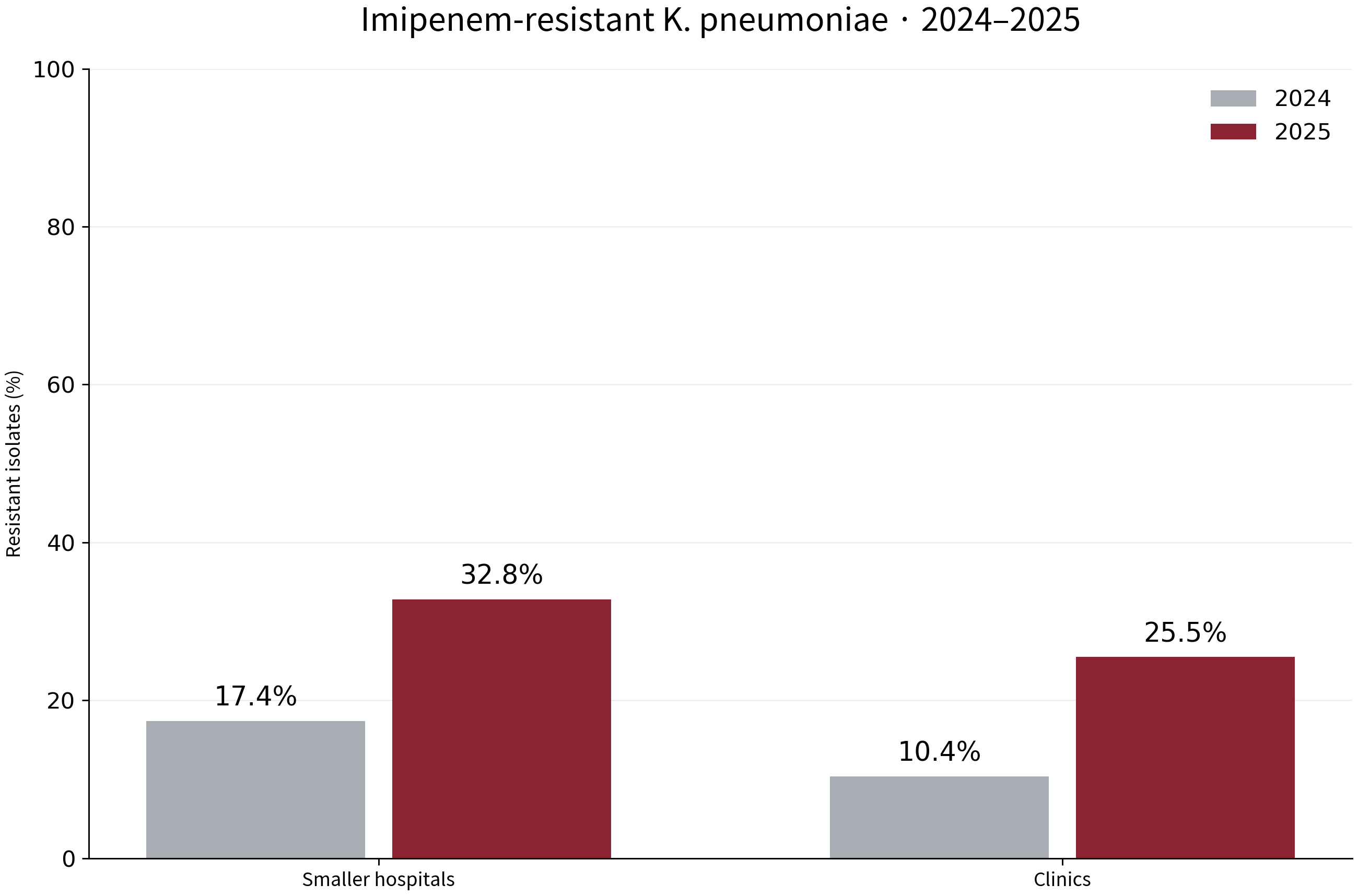
The analysis uses the smaller-hospital and clinic Klebsiella pneumoniae resistance figures in today's release that agree with the annual report's tables. The drug-specific comparison is resistance to imipenem, a carbapenem antibiotic. The reported proportions were 17.4% in 2024 and 32.8% in 2025 for smaller hospitals, and 10.4% and 25.5% for clinics. The report describes surveillance based on tests referred by healthcare facilities to laboratory providers. The denominator is therefore the isolates included in the relevant analysis, not all residents or everyone attending a facility. An isolate is a bacterium separated from a specimen for testing.[4]
The long-term-care hospital figures differ between today's release and the annual report. The available material does not establish whether definitions or an editorial process explain the discrepancy. Those values have therefore neither been silently corrected nor combined with other institutions. The figure shows only the two categories with matching values. Exclusion does not imply that long-term-care hospitals are unimportant or that resistance is absent there. Once a correction or explanation becomes available, comparisons using consistent definitions can be reconsidered. Not treating an unavailable value as zero is part of the analysis.
The figure explicitly labels 2024 and 2025 to distinguish observation years from publication. Changes were calculated by subtracting the earlier proportion from the later proportion and are expressed in percentage points. This is an arithmetic comparison of the distance between the reported values. Relative changes were also retained in the calculation record, but are not the main measure discussed here because different starting values can encourage exaggerated interpretations. The two institutional percentages were neither added nor averaged to produce a national estimate. Proportions with different denominators cannot simply be combined.
Matching the institution, organism, drug and year is more important than checking decimal agreement alone. A proportion based on blood isolates and one combining several specimen types remain different statistics even if their numerical values happen to match. Different numbers of tests for different drugs also imply different denominators. This analysis redraws the matching annual proportions from the release and uses the annual report to check definitions and values. It does not crop or alter the report's existing graphics. Reuse conditions and the accuracy of the observations were examined separately.
Results: substantial changes require careful interpretation
The observed difference was 15.4 percentage points in smaller hospitals and 15.1 percentage points in clinics. Their similar magnitude does not establish that the same process occurred in both settings. If referrals became more concentrated in particular patient groups, surveillance proportions could reflect changes in testing alongside changes in transmission. Conversely, the possibility of a changing tested population does not disprove a real rise in resistance. The data clearly show higher reported proportions; the contribution of different underlying processes remains a question for further analysis.
Values reported to one decimal place involve rounding. Under conventional rounding, each annual value could lie within approximately 0.05 percentage points of the displayed figure, and the difference between two values could vary by approximately 0.1 percentage points. That would not reverse the direction of either observed increase. This is only a sensitivity check for rounding. It does not quantify uncertainty from representativeness or changes in the population tested. More precise arithmetic does not make the underlying data more representative.
| Setting | Year | Resistance (%) | Tested isolates N |
|---|---|---|---|
| Smaller hospitals | 2024 | 17.4 | 20,245 |
| Smaller hospitals | 2025 | 32.8 | 25,220 |
| Clinics | 2024 | 10.4 | 17,251 |
| Clinics | 2025 | 25.5 | 22,580 |
A large number of laboratory results does not automatically constitute an independent random sample. Patients in the same facility may share care environments and referral practices. Changes in participating institutions or patient composition between years also need examination. Accordingly, no new p-values or confidence intervals are calculated here. Resistant-isolate counts, deduplication procedures, institutional sampling structure and longitudinal data from the same institutions are needed before choosing an appropriate statistical model. This is also why the release's proportions cannot be presented as an individual's probability of infection or treatment failure.
These limitations do not make the figures irrelevant. Hospitals cannot wait for all uncertainty to disappear before preparing. Rather, uncertainty changes what preparation should address. Instead of using these data alone to change a particular prescription across the board, a useful first step is to check whether current local and institutional laboratory information reaches the clinicians who need it. National surveillance indicates where scrutiny is warranted; decisions for individual patients depend on their circumstances and relevant institutional information. Keeping these levels distinct becomes especially important when striking figures could otherwise generate anxiety without improving practice.
What the evidence supports—and what it does not
CDC's hospital antibiotic stewardship guidance describes organizational requirements including accountability, pharmacy expertise, action, tracking and feedback. Its aim is appropriate treatment, rather than an unconditional reduction in antibiotic use. It discusses stewardship alongside sepsis care. Sepsis is an emergency in which the response to infection causes serious organ dysfunction. This column draws on the guidance's organizational aspects; it does not determine drug selection or treatment timing for an individual patient. Applying a US framework in Korea also requires checking whether roles and resources are comparable.[5]
The 2017 Cochrane review by Davey and colleagues evaluated interventions to improve inpatient antibiotic prescribing. Its publicly available abstract reports comparatively strong evidence for better policy-concordant prescribing and shorter treatment duration, while variation in microbiological outcomes prevented a dependable general estimate of resistance reduction. It also reports concerns about treatment delays and damaged professional trust under restrictive interventions. The review supports improvement efforts with safeguards, rather than guaranteeing an equivalent effect in a disaster or a particular Korean institution today. Its literature search ended in January 2015.[6]
A practical inference is that prescribing review should not be reduced to a single control procedure. If an urgent decision stalls while authorization is pending, the procedure's effect may conflict with its purpose. Conversely, reviewing every prescription only retrospectively may mean some reviews arrive too late. The choice depends on the clinical service and available expertise. This column proposes making exceptions recordable and reviewable. Treating an exception itself as a failure can drive necessary decisions out of the record.
For infection prevention, Storr and colleagues' account of WHO's core components considers staffing, workload and bed capacity together. It explicitly describes the relevant recommendation as strong while rating the supporting evidence very low quality. A strong recommendation is not synonymous with high certainty: the need to avoid harm, feasibility and expert judgment also inform recommendation strength. The paper also addresses access to hand-hygiene supplies, but does not provide an effect size showing that a particular measure will reduce resistance by a fixed amount during a Korean disaster.[7]
For outpatient care, CDC's 2026 update emphasizes support at health-system level alongside activities in individual practices. This should not be interpreted as requiring a clinic to employ the same staff as a general hospital. It offers a framework for organizing access to advice and feedback despite differences in size. This column uses the overview and its implementation direction, not a claimed review of every accompanying document. Specific Korean requirements must be determined separately against domestic guidance and clinical circumstances.[8]
The diagnostic pathway can disappear from emergency plans
Medicine inventories are conspicuous in preparedness reviews. The pathway from specimen receipt to recognition of a result is less visible because it crosses departments. An operational exercise suggested by these findings is to follow one case from test request to reassessment after the result. This is not a recommendation to increase testing for every patient. It seeks points where a test judged necessary by the treating team could be interrupted or its result lost. Numerical targets should not replace the clinical judgment that distinguishes necessary from unnecessary testing.
Consider a hypothetical example. A transport disruption prevents a contracted laboratory's collection vehicle from reaching a hospital. Staff can collect specimens and medicines remain available, but the night team has not been told that collection times have changed. The relevant question is not simply whether the laboratory is open. It is whether someone is responsible for alternative transport, someone can verify specimen-specific handling requirements, and the clinical team can be informed of delayed results. This is a training scenario, not an account of an actual event.
Exercises should define where a timed interval begins and ends. Time from collection request to vehicle departure differs from time between specimen collection and laboratory receipt. Reporting only a shorter average can conceal the longest delays. Reviewing the median alongside prolonged cases, with brief explanations for delay, is a proposed alternative. Patient identifiers should be limited to what the exercise needs, and public reporting should use aggregates that do not reveal individual care pathways.
A result appearing on a screen does not mean it has reached its destination. What matters is whether the person responsible for reassessing treatment has actually seen it. The distinction becomes clear when a result arrives after a ward move, discharge or transfer to another institution. Regional partners can agree who will contact whom in that situation. Successful communication should be measured separately from whether treatment changes. A clinician may appropriately retain the existing prescription after a result has been communicated successfully.
Turning additional beds into functioning care
Plans to add beds should include the staff and infection-prevention work required in the additional space. These resistance statistics do not establish overcrowding in any particular hospital. They nevertheless invite an operational question about the burden of expansion that cannot sustain infection prevention. Providing a bed and sustaining care at that bedside are different achievements. Clinical capacity depends on people being able to carry out all the necessary work consistently. If a new area's cleaning, replenishment, specimen transport and prescribing review responsibilities are unspecified, those parts of the plan remain incomplete.
One hypothetical exercise would map the tasks required when part of an ordinary ward becomes a temporary clinical area. The map could identify patient and staff routes, hand-hygiene supplies, waste handling and specimen movement separately. Before moving real patients, frontline staff could use it to identify inconvenient or ambiguous arrangements. This is not a validated prediction that a particular layout will prevent a specified number of infections. It is a way to identify differences between a written plan and actual working conditions.
Staffing plans must also distinguish names on a roster from time available to perform the work. Even trained staff may have little capacity to support additional space if they retain other essential responsibilities. Instead of recording only the number assigned by each department, the plan could specify which tasks they can cover and for how long. This distinction also prevents organizational shortages from being blamed on individuals. Demanding compliance while assigning an unmanageable workload may produce metrics without revealing causes that can actually be addressed.
The purpose is not to discourage emergency admissions. It is to decide earlier how additional space can function safely when patients need it. Regional collaboration may allow some functions to be shared. Duplicating equipment everywhere and concentrating it at one institution have different costs and vulnerabilities. Considering disrupted roads and communications makes the appropriate answer even more locally dependent. Alternative plans should therefore describe not only their advantages but also what happens if the preferred arrangement fails.
Emergency transport, transfers and vulnerable patients
Prehospital emergency care includes assessment at the scene and transport to an appropriate facility. This analysis does not justify ambulance personnel independently classifying patients or choosing antibiotics from a national resistance percentage. They can instead help agree what information is needed during transfers. Distinguishing known test results, information awaiting confirmation and precautions currently in place gives the receiving service a basis for preparation. Information sharing must remain within relevant protocols and professional authority and should avoid unnecessary disclosure of sensitive details.
A label of antibiotic resistance should not become a stigma that replaces the patient's clinical story. A warning without the specimen, organism and date can obstruct rather than support decisions. Transfers require information that enables care to continue, not a rationale for excluding a patient. This column does not prescribe isolation procedures or criteria for ending precautions. It proposes assessing information accuracy and access to necessary care together. Explanations to families should similarly distinguish established findings from matters still requiring confirmation.
Omitting long-term-care hospital values from the figure does not remove the needs of people receiving prolonged care from the discussion. For patients moving between institutions, results, medication records and future plans may be scattered across documents. Asking patients or families to explain everything accurately is insufficient. Institutions should organize the information to be checked and assign necessary contacts. Hearing or visual difficulties, language barriers and the absence of a caregiver may require different communication methods. These conditions should not be grouped under a patient's supposed lack of cooperation.
For someone returning home after an outpatient visit, a contact method must work in practice. Having a telephone number in the record is not the same as being able to reach the person. A hypothetical exercise could examine what to do when a delayed result arrives and initial contact fails. More calls should not itself define success. The evaluation should consider whether necessary clinical judgment followed while respecting privacy and living circumstances. If contact becomes an end in itself, workload and inconvenience may increase without a corresponding benefit.
Alternative explanations and the cost of implementation
The most important competing explanation for the observed increase is a change in the surveillance population. Participation by institutions that test more often, or more referrals from patients already experiencing difficult-to-treat illness, could increase the proportion. Testing this explanation requires analyses restricted to the same institutions and stratified by specimen type. Conversely, the absence of those data does not justify dismissing actual transmission. A reasonable response is to examine local data quality and care processes without declaring a cause, while obtaining information that supports better comparisons.
A falling surveillance proportion should not automatically be reassuring either. Reduced referrals or missing results could make an indicator look better. This is not a claim that either occurred today; it is a logical requirement for evaluation. An improvement programme should examine both outcomes and the processes producing the data. Displaying analyzable specimen counts and missingness alongside resistance trends can help readers understand the figures. An initial rise in detected adverse findings as missingness decreases should not automatically be called failure.
Prescribing review requires staff time. Adding reporting fields in a small institution can take time away from patient care. This column therefore proposes starting with information already available in existing records rather than demanding many new indicators. A new field is easier to justify when someone can explain who will use it and for which decision. Collecting information without returning useful findings to frontline teams is difficult to defend. Evaluation can include the additional time the programme requires from staff.
Technology does not automatically resolve these problems. Numerous alerts may obscure important results, while incompatible terms can change the meaning of information transferred between institutions. Agreement on the minimum information and responsible roles is a practical first step before introducing another system. Digitization can then be tested for whether it makes that agreement easier to carry out. A paper fallback should also work during communications failure, with a plan for reconciling records after restoration.
A regional pilot that can be evaluated
If regional providers and public health authorities start a pilot, the first task is to narrow its population and purpose. One option is to examine whether microbiology results arriving after a transfer reach the responsible clinician. This addresses a currently observable workflow more directly than a promise to lower the overall resistance rate within a short period. The observation period, institutions, result types and definition of completed communication should be documented in advance. Even a small pilot can inform the next change if its definitions remain consistent.
One proposed indicator is the proportion of eligible results with a record that the responsible person acknowledged them. The denominator should include all results meeting the pilot criteria; cases without a contact number should not quietly disappear. A second measure could examine time to acknowledgment, after agreeing whether it starts when a result is finalized or when the institution receives it. Without that definition, comparisons between institutions are meaningless. Missing values should remain explicitly unconfirmed, and genuine delays should be distinguished from missing documentation where possible.
For prescribing review, completion of review and a change in prescription should be recorded separately. Defining a higher change rate as better performance could encourage unnecessary changes when continuation is appropriate. More useful questions include whether the reason and judgment were documented, advice was available when needed, and urgent care was not delayed. Appropriateness criteria must follow the institution's guidance and expert review arrangements. This proposal concerns an evaluation structure, not a rule for judging individual prescriptions.
Balancing measures are also necessary. After strengthening result communication, institutions should assess additional contact work and any disruption to other essential tasks. Reports of urgent decisions delayed by prescribing review need a separate route for examination. If such problems cannot be discussed openly, programme performance may appear better than it is. Reporting should collect evidence for improving work arrangements rather than become a mechanism for judging staff who raise concerns. Explanations that patients and families found confusing can also inform improvement.
Even visible changes before and after a pilot should not immediately be reported as causal effects. Patient mix, circulating infections, staffing or laboratory providers may have changed over the same period. Where feasible, observations over several time points are preferable, and comparisons with nonparticipating institutions require assessment of their similarity. Other institutions should not face disproportionate additional work simply to supply a comparison. A practical sequence is to begin with descriptive statistics and case review, then strengthen evaluation design as the data structure improves.
A supplementary analysis could first examine change within the same institutions. Comparing the overall trend with the trend among continuously participating institutions can narrow interpretation. If the two differ, neither should be concealed; changes in participation should be investigated. Rules excluding institutions with few referrals should not be improvised after viewing the results. This analysis would require institution-level information and authorization to access it. It has not been performed using the public aggregate table. Specifying the additional data needed is itself a useful starting point for the next investigation.
Recovery should also be included in the evaluation plan from the outset. Restored transport or information systems do not automatically resolve all outstanding results. The final stage of a hypothetical exercise could reconcile test requests and results recorded temporarily during an outage. The responsible team would distinguish duplicates from records still awaiting confirmation and assign the remaining work and its deadlines. Completion percentages alone may push difficult cases into the background, so reasons for noncompletion and next actions should also be retained. This proposal defines recovery through outstanding clinical work as well as functioning equipment.
Public explanations should differ from internal management metrics. Suggesting that care at a particular institution necessarily leads to infection adds a risk claim the data do not support. Conversely, saying only that the percentage concerns tested bacteria can minimize why improvement matters. It is better to explain the observed change, the unresolved causes and the work institutions intend to examine together. Patients should be offered a route to ask their treating team questions, rather than be asked to change prescriptions themselves. Checking what people understood may be a more meaningful communication measure than counting leaflets distributed.
Bringing the figures back to care
Today's announcement does not mean that every patient needs a stronger antibiotic. It asks whether institutions can interpret differing surveillance signals and distinguish necessary treatment from unnecessary use. Preparedness can assume that weak links in ordinary services may become more visible during an emergency, but these data do not establish a disaster as the cause of today's resistance increase. Staying within the evidence makes the practical task clearer: identify where specimen transport, result acknowledgment, prescribing reassessment or infection-prevention work could fail.
Developments in the Democratic Republic of the Congo and Kenya cannot prove the same conclusions as Korean resistance surveillance. They do, however, show why expanded facilities, community access, a last patient's discharge and continued surveillance address different questions. Korea also benefits from distinguishing resources held, work that can actually be performed and care that patients receive. A modest local action after reading today's report is to follow one laboratory result all the way to the person who needs it. Correcting the gaps found and measuring again is how an annual statistic can begin to improve daily care.
References
- [1] 질병관리청. [11.16.보도참고자료] 「2025 국가 항균제 내성균 조사 연보」 발간. 2026-11-16.
- [2] WHO Regional Office for Africa. Six months on, accessing hard-to-reach communities key to halting Ebola outbreak. 2026-11-15.
- [3] WHO Regional Office for Africa. Kenya’s last Ebola patient goes home as 42-day countdown begins. 2026-11-11.
- [4] 질병관리청. 2025 국가 항균제 내성균 조사 연보. 2026. KARMS methods and Tables 2-22–2-24; Figure 3-11.
- [5] CDC. The Core Elements of Hospital Antibiotic Stewardship Programs: 2019. Atlanta: CDC; 2019.
- [6] Davey P, Marwick CA, Scott CL, et al. Interventions to improve antibiotic prescribing practices for hospital inpatients. Cochrane Database Syst Rev. 2017;2:CD003543. doi:10.1002/14651858.CD003543.pub4. Public abstract and evidence summary.
- [7] Storr J, Twyman A, Zingg W, et al. Core components for effective infection prevention and control programmes: new WHO evidence-based recommendations. Antimicrob Resist Infect Control. 2017;6:6. doi:10.1186/s13756-016-0149-9.
- [8] CDC. Core Elements of Outpatient Antibiotic Stewardship. 2026-08-03. Overview.
Korean resistance surveillance and recent Ebola updates frame an analysis of comparable data, diagnostic pathways, prescribing review and infection-prevention capacity.
SCH-COLUMN-2026-11-16,EN,AMR-CARE-CAPACITY