[EN] Emergency departments that sustain elimination: returning measles and gaps in healthcare systems | 2026-11-17
관리자
SCH Disaster Medicine Center — Analysis
2026-11-17 · SCH-COLUMN-2026-11-17 · MEASLES-READINESS · EN
What today's developments ask of us
On November 17, 2026, the Korea Disease Control and Prevention Agency (KDCA) announced that Korea had maintained measles elimination status for the thirteenth consecutive year. Although the release is labelled for the November 18 morning press, its website publication date and domestic news coverage are November 17. Recognition followed a regional committee assessment in September and a decision in October. This is neither news of a new infection today nor the first achievement of elimination. It recognizes sustained efforts to prevent imported infections from establishing continuous domestic transmission.[1]
The picture overseas differs. The US Centers for Disease Control and Prevention (CDC) updated its surveillance page on November 13, reporting 5,412 confirmed cases in 2026 through November 12. This is not a daily count and does not include every suspected case. Differences in population size and reporting systems prevent a simple comparison with Korea as a ranking of public health performance. The figures nevertheless make it difficult to treat measles abroad as a problem belonging entirely to the past.[2]
A third development is CDC's global measles surveillance table, updated on November 12. It presents provisional reports to the World Health Organization for April through September 2026. A November update does not make it a real-time account of November transmission. Korea's recognition, recent cumulative US notifications, and a global table covering a defined interval describe different situations. Rather than combining them into a single growth rate, this column uses them to examine the capabilities healthcare institutions need to retain after elimination.[3]
For a general reader, elimination may suggest that cases can no longer occur. Yet recognition rests on continuing surveillance and response. For a hospital, practical questions come before national status. Who notices the risk when someone arrives with fever and a rash? Where does that person wait after suspicion arises? How are other patients and staff protected before test results return? Sustaining a national achievement begins with keeping these routine connections intact.

Define the comparison before interpreting the numbers
This analysis uses CDC's US confirmed-case aggregate. The global country table was excluded from a country-ranking analysis because its observation period differs and reporting delays and surveillance intensity vary. No full-year projection was made for 2026. Cumulative notifications through November 12 were fixed as a snapshot and divided into outbreak-associated cases and the remainder. The observational unit is a reported confirmed case; the denominator is all 5,412 cases in that snapshot. These are not incidence rates using population or traveller numbers as denominators.[2]
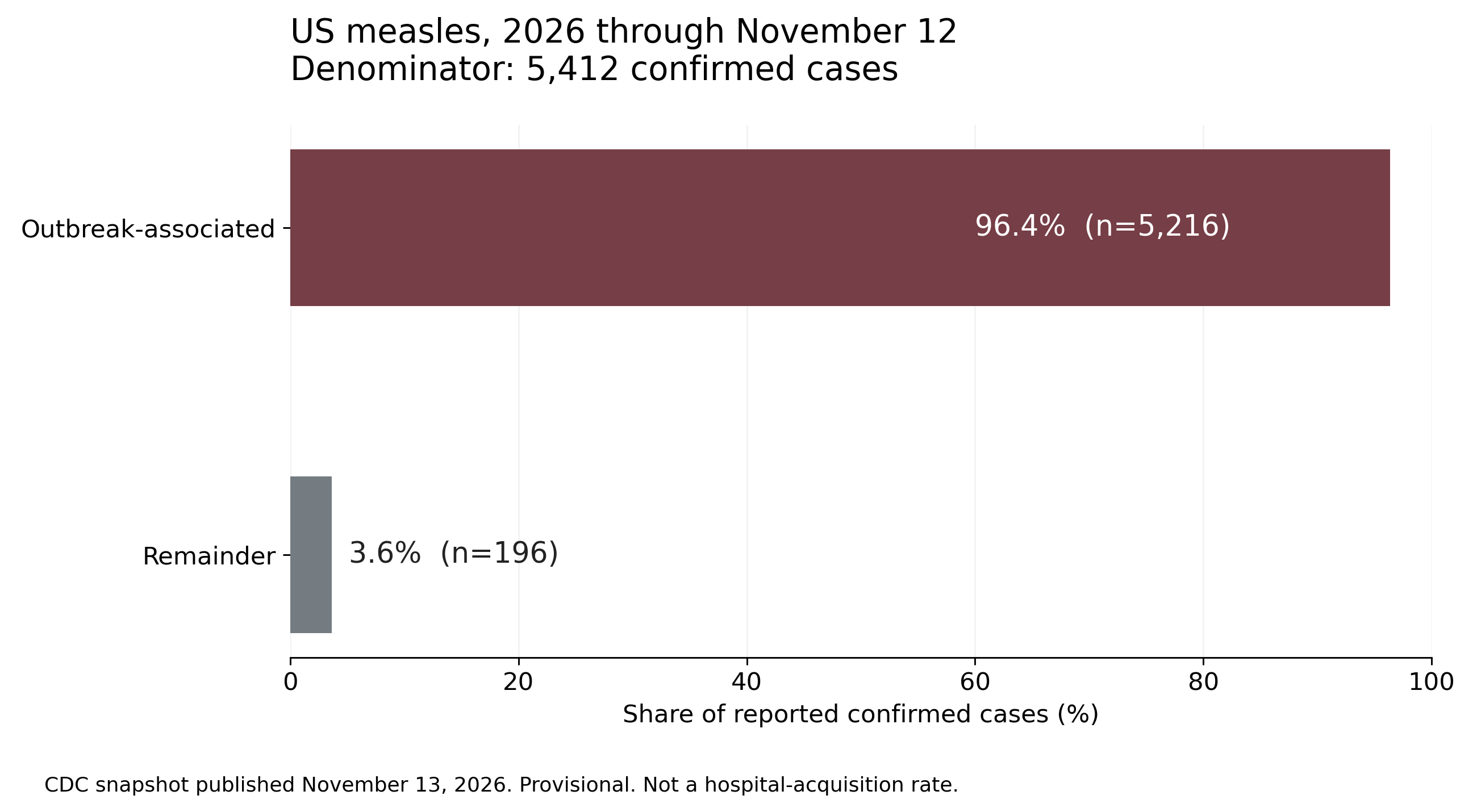
Of those cases, 5,216 were outbreak-associated. Subtracting them from the total leaves 196, yielding proportions of 96.4% and 3.6%. The categories sum to the original total of 5,412. Rather than presenting the source's rounded 96% as a more precise value, the proportions were recalculated from published counts to one decimal place. The remaining 196 cases are those not classified as outbreak-associated in this aggregate. They should not be described as fully investigated, independent sporadic infections.[2]
This composition matters because response may need to continue beyond the care of one patient. However, 96.4% is not the proportion infected inside hospitals. These two categories cannot distinguish transmission in households, schools, or other community settings. Cases belonging to the same outbreak are also related, so they were not treated as independent observations to generate precise confidence intervals or significance tests. Figure 1 describes the observed composition; it does not test whether an intervention worked.
| Classification | n | % |
|---|---|---|
| Outbreak-associated | 5,216 | 96.4 |
| Remainder (calculated) | 196 | 3.6 |
| Total | 5,412 | 100.0 |
The provisional nature of the data also affects interpretation. Both totals and categories may change as cases are added and epidemiological links become clearer. A difference between today's downloaded table and next week's version is not, by itself, evidence of error or concealment. Publication dates, reporting cutoffs, and case definitions must be retained to explain revisions. This analysis does not estimate missed infections or assume that people absent from surveillance are healthy. Missing information remains unresolved.
The same reasoning explains why a prominent annual comparison was avoided. Comparing a complete year with an unfinished year can describe accumulated burden but cannot establish a change in risk over equivalent periods. Scaling the current cumulative count by the days remaining would assume a stable trajectory that these data do not support. Hospitals need evidence that their response processes work more than they need an unsupported year-end forecast.
Directly transferring the numbers to Korea would be particularly misleading. Multiplying Korean emergency department attendance by the US proportion cannot estimate isolation-room requirements. Local vaccination histories, travel patterns, healthcare use, and diagnostic access differ. The aggregate instead raises an operational question: should a suspected case prompt consideration of connected exposures rather than be treated only as an isolated encounter? Actual resource planning requires Korean local surveillance and information about movement through individual hospitals.
What the evidence supports—and what remains uncertain
CDC's healthcare guidance links advance notification, prompt identification and separation at entry, and airborne precautions. Airborne precautions address spaces and respiratory protection in relation to particles that can carry infection. Advance notification by emergency services transporting suspected cases belongs within this sequence. The key is to avoid assuming that one screening form can resolve every risk. Guidance calls for multiple protective processes; the operational proposals in this column concern how to test their connections locally.[4]
Staff protection is a separate component. CDC's healthcare personnel guidance addresses evidence of immunity, infection prevention, and work exclusion for potentially infectious personnel. Recalling vaccination is not the same as having verifiable records available to an institution. Conversely, an unavailable record does not establish an absence of immunity. Institutions should identify verification routes and responsible staff in advance. Individual decisions after exposure belong to occupational health and infection prevention teams applying current Korean requirements.[5]
Walls and doors alone do not define exposure. CDC's exposure-assessment appendix considers shared airspace and recommends involving staff responsible for ventilation. It does not regard risk as zero simply because a patient wore a mask and moved promptly. It also explicitly notes that the effectiveness of patient source-control measures against measles has not been formally studied in healthcare settings. Neither ending an investigation because a mask was supplied nor classifying every movement as equally high-risk is justified.[6]
Evidence on vaccination differs in character from operational guidance. The Cochrane systematic review by Di Pietrantonj and colleagues assessed the benefits and harms of combined vaccines in children. Here, the 2020 public abstract that was actually examined is used only to support the existence of accumulated evidence of protection. A subsequent update exists, so this abstract is not described as the latest complete review. Findings primarily concerning healthy children cannot simply be assigned to exposed adult healthcare workers or a particular Korean hospital.[7]
WHO describes how disrupted routine immunization and crowded living conditions in disasters and conflicts contribute to measles risk. This helps explain why measles belongs within disaster medicine. It does not predict that every Korean evacuation shelter will experience an outbreak. Risk depends on the number and distribution of susceptible people, whether infection is introduced, and whether care and vaccination remain accessible. Disease characteristics must be considered alongside conditions on the ground.[8]
Taken together, vaccination and healthcare infection prevention are not substitutes. Even with substantial community protection, hospitals concentrate people who may be vulnerable. Conversely, excellent hospital pathways cannot prevent a continuing influx of risk if more people cannot access vaccination in the community. This changes the budget discussion. Instead of choosing between isolation capacity and vaccination support as mutually exclusive options, institutions should identify where connections fail and allocate resources accordingly.
Response begins before the emergency department door
The first operational proposal is to create an entry point through which concerns can reach clinical staff. When a patient calls, reception staff need to know what to ask and whom to contact. Requiring a complex clinical questionnaire for every call could lengthen conversations and delay other urgent requests. Reception staff should therefore pass warning signs to a clinician rather than diagnose. Confirmation that the handover was completed is necessary if the process is to achieve more than leaving a message.
People arriving without calling need a different design. In some hospitals, registration staff are the first contact; elsewhere, security personnel or volunteers meet patients first. Excluding them from training leaves a gap at the entrance, where patients may spend considerable time. Brief instructions, a contact number for assistance, and a culture that does not penalize staff for raising concerns are useful. Non-clinical staff should not, however, be expected to confirm disease or refuse access to care.
A common operational mistake is to assume that the next destination is settled once a suspected case has been recognized. An inventory listing an isolation space is insufficient. Someone must be responsible for deciding what happens when that room is occupied or under maintenance. The alternative should not be an improvised move to another waiting area, but a joint assessment of risk and urgency by clinical and infection prevention leads. Smaller institutions may particularly benefit from regional contacts supporting that decision.
Potential conflict between emergency treatment and infection prevention also needs rehearsal. Assessment of infection risk must not delay treatment of a life-threatening condition. At the same time, urgency does not remove the need for subsequent exposure records and protective measures. Institutions can review movement and staff roles for patients requiring immediate treatment and test them in simulation. This is an organizational preparedness proposal, not a single treatment instruction applicable to every patient.
In testing, what matters is whether results lead to action, not merely whether a specimen was collected. Breaks in communication between referring services, transport personnel, and the receiving clinical team should be identified. The first person responsible for reviewing a result, overnight cover, and handover requirements should be explicit. A dashboard displaying only positive or negative results cannot show these delays. Separating laboratory processing, transport, and result-review times also clarifies which parts of the process need improvement.
Connecting emergency transport and regional hospitals
Emergency medical services—the system assessing and transporting patients from the scene to hospital—can evaluate the quality of advance notification. A record that a call occurred is different from confirmation that the receiving team understood the necessary information. The reason for suspicion, clinical urgency, and expected arrival are examples of information relevant to preparation. Personal information should not be spread through open radio channels or unnecessarily broad group chats. Reaching the appropriate people with the necessary details supports both speed and privacy.
Receiving institutions must respond as well. Without instructions about the entrance, receiving staff, and contact route if plans change, advance notification loses its value. In interhospital transfer, departure from the sending institution must be distinguished from readiness at the destination. Agreement to transfer and actual preparation for arrival should not share a single checkbox. Regional groups can examine omissions in these handovers case by case without automatically assigning every delay to institutional fault.
Vehicle availability alone is also an inadequate measure of performance. Returning ambulances to service promptly matters, but exposure assessment and necessary environmental management must also be checked. Conversely, holding all vehicles out of service for a prolonged period merely because infection is possible can burden other emergency patients. A responsible team needs to apply actual exposure conditions and applicable standards to each vehicle. This column introduces no universal ambulance turnaround time or new disinfection protocol.
Small healthcare facilities cannot readily reproduce the equipment of major hospitals. They still have an important role: recognizing concern promptly, limiting unnecessary waiting and movement, and connecting patients to appropriate services. Regional resource lists should include operating hours and actual receiving conditions, not just institution names. Outdated lists can trigger repeated calls during a crisis. Short, periodic communication exercises offer a practical way to identify such gaps.
Protecting staff and vulnerable patients together
Staff immunity-record systems should not cover only directly employed permanent workers. Trainees, temporary staff, cleaners, and maintenance personnel also enter patient areas. This does not require collecting excessive personal information centrally. Institutions can track the verification status needed for work and routes to further consultation, while detailed health information remains with authorized personnel. People lacking records need time and access to verification and follow-up rather than blame.
Work arrangements after staff exposure are inseparable from workforce planning. A scenario in which several people in one department must stop working requires consideration of replacement staff skills and existing patients' care. Filling empty slots on a roster may not be sufficient. Institutions should identify essential functions and the limits of support available from other departments. Individual exclusion decisions follow official guidance and assessment; management must create the organizational capacity to implement them.
For vulnerable patients, advice to avoid risk is not enough. People needing repeated treatment cannot simply stop attending hospital. They need concrete arrangements concerning waiting areas, possible appointment adjustments, and access to advice. Creating anxiety for families with young infants or immunocompromised patients without providing alternatives could delay necessary care. Individual preventive or therapeutic decisions require clinical assessment, but institutions can immediately improve access to that assessment.
Language and record barriers warrant separate attention. Linking overseas exposure to nationality or appearance can produce stigma and missed questions. Applying appropriate, consistent questions to all patients and offering interpretation or plain-language instructions is more accurate. People who struggle to locate vaccination records need guidance on what evidence can be obtained and where. Treating uncertainty as uncertainty, rather than refusal or indifference, can improve both the accuracy of information and cooperation.
Applying these principles during evacuation and recovery
Shelters differ from hospitals: residents sleep, eat, and stay with their families. Routes to clinical assessment for fever or rash must connect with the organization of shared living spaces. Shelter managers should not diagnose measles or exclude residents arbitrarily according to vaccination status. Health authorities and medical teams should assess health concerns, while support teams facilitate communication, transport, and continuing care. Responsibilities need to be clear.
Consider a hypothetical application. Several families are staying in a gymnasium after flooding, and one child develops fever and a rash. This is not an account of an actual Korean incident. The shelter team connects the family to medical assessment and helps them understand instructions. Clinicians assess infection risk and urgency and discuss necessary measures with public health authorities. Meanwhile, alternative space and caregiving arrangements are considered so other families retain support. The aim is to reduce gaps between roles, not merely to attach a disease label quickly.
In this hypothetical case, tracing contacts requires more than collecting names. Investigators need to establish who was present, when, and in which spaces, but movement and household arrangements may change frequently during a disaster. Records should contain the minimum necessary information, permit corrections, and restrict access. Family names and health status should not be posted publicly. Viewing privacy only as an obstacle overlooks the costs of inaccurate information and reduced cooperation.
Recovery must include restoration of routine preventive services. The end of evacuation does not necessarily resolve access problems. Changed addresses and caregivers' return to work can lead to missed appointments or difficulty finding records. Public health services can establish contact routes to identify interruptions after a disaster. Examining transport, time, cost, and information barriers, rather than assuming family fault, is more likely to reveal problems that can be corrected.
Alternative interpretations and opportunity costs
The objection that such preparation could be excessive deserves consideration. Korea maintains elimination status, and responding identically to every febrile patient could rapidly consume space and staff. The proposal is therefore not indiscriminate isolation or testing. It is a reliable process for raising concerns, reassessing them clinically, and adjusting measures. Delays to other patients caused by excessive response also need measurement if the benefits and costs of preparedness are to be assessed.
Another objection is that the high outbreak-associated proportion may partly reflect reporting practices. Outbreak investigations actively seek linked cases, potentially producing different ascertainment from sporadic infections. These data cannot separate the magnitude of that effect. Observed composition was therefore not used to infer biological transmission characteristics or the extent of policy failure. Acknowledging reporting effects does not, however, remove the confirmed cases or the work required to respond to them.
Vaccination messages must also address concrete access barriers. Assuming information alone will resolve every missed vaccination overlooks people unable to find time or access records. Focusing only on access while ignoring misinformation and distrust is insufficient too. Local assessment should identify the obstacles actually operating. Alongside coverage, services can track whether counselling leads to the care or support a person needs.
There is no single solution for facilities either. Additional isolation space may help over the long term, but construction, staffing, and maintenance all matter. Improving the use of existing rooms and overnight contacts may be faster. The preferable approach depends on the present bottleneck. A hospital with adequate space but delayed communication needs a different response from one with rapid communication but nowhere to separate patients. Observation should precede decisions about improvement priorities.
Preparedness that can actually be evaluated
Hospitals can begin by distinguishing the time concern was recognized, the time the patient reached an appropriate separated location, and the time infection prevention staff received the information. These timestamps represent different processes. Definitions and recording responsibilities should be agreed before data collection, avoiding numbers that mean different things across departments. Rather than assigning arbitrary universal targets, institutions can examine current distributions and identify recurrent delays. These are proposed indicators, not validated national standards.
Averages alone can hide occasional long delays. Hospitals with few cases may benefit from reviewing each anonymized pathway. As observations accumulate, medians and ranges can be reported, with distinctions between operational conditions such as overnight versus daytime attendance or ambulance versus walk-in arrival. Excessive subdivision, however, can turn chance differences in a handful of cases into apparently meaningful disparities. Small samples require visible uncertainty and an emphasis on explaining the improvement process.
Training should not be evaluated solely by attendance. Comparable simulations before and after training can show whether notifications reach the appropriate staff and whether an alternative location can be identified. Familiarity with the exercise must be distinguished from improvement in real practice; better simulation performance is not automatically evidence of fewer infections. Gathering difficulties encountered in subsequent work helps establish whether the exercise reflects actual operations.
Balancing measures can include other patients' waiting times and staff workload. Faster infection prevention processes do not establish overall improvement if emergency treatment elsewhere is delayed. Conversely, an initial increase in documentation may yield fewer handover failures later. Evaluation periods and comparators should be specified, and both kinds of outcome examined. Displaying competing objectives is often more useful for decisions than combining numbers into a single ranking.
Regionally, contact accuracy and current receiving conditions can be checked. A scheduled test call should establish not only whether someone answers but also whether it reaches the person able to make the necessary decision. Exercises should minimize disruption, and failures should support improvement rather than punishment. Correcting one wrong number may be more immediately useful than producing a large new plan, but its value should still be confirmed through subsequent successful contact.
Finally, improvements must be transferable to the next responsible team. Reports that merely list problems invite the same discussion to recur. Each issue can be linked to a responsible department, a specific correction, and a date for checking completion. Yet a document that becomes primarily a record of personal fault may reduce reporting from the frontline. Accountability remains necessary, but its focus should be what needs to change to make the next patient's care safer.
Missing data should itself be recorded as a finding from the outset. If recognition times are frequently absent, it may be impossible to distinguish delayed response from prompt action without time for documentation. Filling blanks with registration times creates a superficially complete table but may misrepresent the process. Institutions should first examine the frequency and reasons for missingness and consider simpler recording methods. The balance between complete data and necessary work at the bedside must also be tested in practice.
Comparisons between hospitals require information about case mix and facilities. Institutions seeing many critically ill patients must combine infection prevention decisions with immediate treatment and may look worse in simple time comparisons. Small services may struggle to maintain experience because cases are rare; large hospitals may face greater coordination demands from complex pathways. Rankings that ignore these differences risk encouraging defensive documentation. Comparisons should support learning about improvements reproducible across different conditions rather than punishment.
Community communication should distinguish established facts from matters still under investigation. Assessing possible exposure in a space does not mean everyone who used it became infected. Notices should explain what affected people need to check and where they can seek advice, without unnecessary identifying details or speculation. A process for explaining later corrections and their reasons can be established in advance. Honest uncertainty helps people choose their next action instead of promising perfect certainty.
The work that remains after recognition
Today's Korean announcement provides grounds to recognize sustained achievement. Overseas data provide a reason not to assume that achievement will maintain itself. These facts are compatible. There is no need to diminish Korea's success or use foreign cumulative counts to exaggerate an immediate Korean crisis. The task is to distinguish observations with different dates and definitions and choose actions suited to questions those observations can actually answer.
From a disaster medicine perspective, measles preparedness extends beyond diagnosing an individual patient. It asks whether that patient can receive necessary care while others and staff remain protected, whether communication holds across hospitals, emergency services, and public health, and whether routine prevention returns after disruption. Connecting national elimination status to frontline capability requires more than repeating a declaration. It means finding small failures in coordination, correcting them, and checking whether care has actually improved.
References
- [1] KDCA. 한국, 세계보건기구로부터 13년 연속 홍역 퇴치 인증. 2026-11-17.
- [2] CDC. Measles Cases and Outbreaks. Updated 2026-11-13; data through 2026-11-12.
- [3] CDC. Global Measles Outbreaks. 2026-11-12; April–September 2026 observations.
- [4] CDC. Interim Infection Prevention and Control Recommendations for Measles in Healthcare Settings.
- [5] CDC. Measles: Infection Control in Healthcare Personnel. 2024.
- [6] CDC. Appendix A: Considerations when Evaluating a Person for Exposure to Measles in a Healthcare Setting. 2025-07-10.
- [7] Di Pietrantonj C, Rivetti A, Marchione P, Debalini MG, Demicheli V. Vaccines for measles, mumps, rubella, and varicella in children. Cochrane Database Syst Rev. 2020;4:CD004407. DOI:10.1002/14651858.CD004407.pub4. PMID:32309885. Public abstract; superseded by a 2021 update.
- [8] WHO. Measles. Fact sheet. 2026-07-15.
Measles elimination recognition and overseas surveillance prompt an analysis of emergency departments, transport and shelters, with explicit data limitations and measurable operational proposals.
SCH-COLUMN-2026-11-17,MEASLES-READINESS,EN