[EN] 2026-11-18 | The surveillance network has expanded. Where does infection prevention begin?
SCH Disaster Medicine Center — Analysis
SCH Disaster Medicine Center — Analysis
2026-11-18 · SCH-COLUMN-2026-11-18 · EN
Four developments today, on different timelines
On 18 November 2026, the Korea Disease Control and Prevention Agency (KDCA) opened recruitment for the 2027 Korean National Healthcare-associated Infections Surveillance System, KONIS. Applications close on 9 December. According to the announcement, 1,381 institutions participated as of October 2026, across seven surveillance areas. This is an expansion of the infrastructure for identifying healthcare-associated infections consistently, rather than an announcement of newly occurring infections today. Participation describes surveillance capacity; it does not establish prevention outcomes. [1]
World AMR Awareness Week also begins today and runs through 24 November. The World Health Organization (WHO) is calling for prevention through One Health, an approach that connects human, animal and environmental health. Antibiotic resistance describes bacteria's lack of susceptibility to antibiotics; the broader term antimicrobial resistance also includes resistance affecting medicines against viruses, fungi and other organisms. The campaign does not declare a new outbreak. It is an international observance calling for preventive action across sectors. [2]
On 18 November, the European Centre for Disease Prevention and Control (ECDC) released its 2025 annual report from the European Antimicrobial Resistance Surveillance Network. The observation year is 2025; the publication year is 2026. Estimated bloodstream infection incidence across the European Union stood at different distances from the 2030 targets for different resistant organisms. The report illustrates what can be missed when resistance is compressed into a single indicator. It is neither a real-time count of patients today nor a scorecard for Korean hospitals. [3]
ECDC also published its fourth rapid risk assessment of carbapenem-resistant Enterobacterales today. Carbapenems are a class of antibiotics, and resistance can make treatment choices more difficult. The assessment rates the probability of further spread in the EU/European Economic Area as high and emphasizes laboratory capacity, infection prevention and coordination between institutions. Its conclusions concern that region's evidence and healthcare conditions. They cannot be transferred directly into a risk rating for Korea. [4]
These four developments are not links in a single causal chain. The Korean announcement concerns recruitment, WHO's event is a campaign, and the two European publications present surveillance findings and a risk assessment. They nevertheless raise a shared question for health systems: once infections become more visible, what changes? This column focuses on the path from information to action, rather than the size of a surveillance network, and considers the conditions needed to sustain care during disasters.

Read the denominator before comparing three numbers
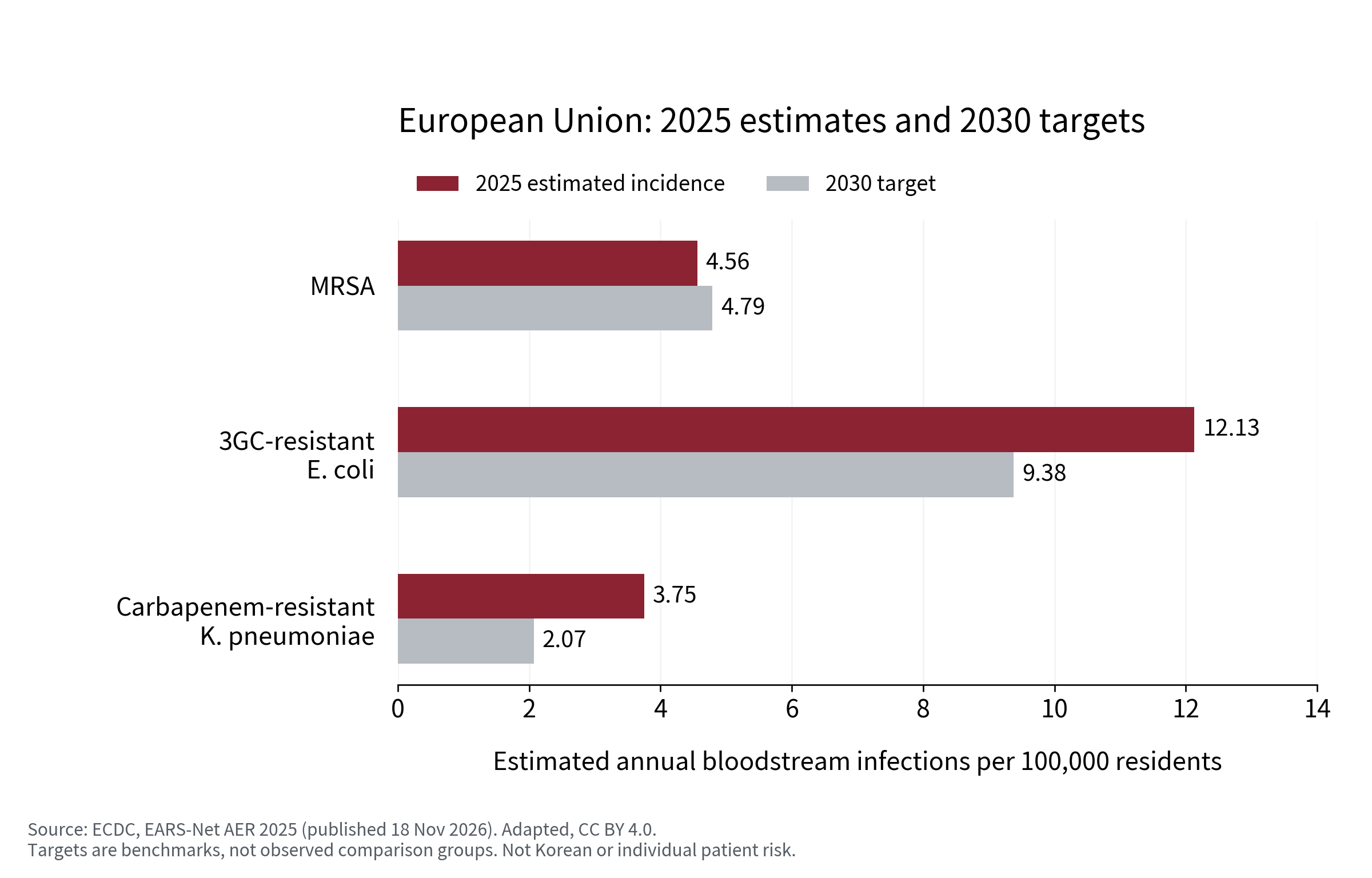
Figure 1 places ECDC's estimated EU incidence in 2025 beside its 2030 targets for three resistant bloodstream infection categories. Meticillin-resistant Staphylococcus aureus is abbreviated MRSA. The other categories are third-generation cephalosporin-resistant Escherichia coli and carbapenem-resistant Klebsiella pneumoniae. These antibiotic names define the comparisons; they are not advice about which medicine an individual should receive. Every value is expressed as estimated annual infections per 100,000 residents.
Transcription of the published values gives an estimated incidence of 4.56 and a target of 4.79 for MRSA. The corresponding values are 12.13 and 9.38 for resistant E. coli, and 3.75 and 2.07 for resistant K. pneumoniae. Subtracting each target from the estimate gives −0.23, +2.75 and +1.68, respectively. A negative difference means the estimate is below the target; a positive difference means it is above. These are not differences in mortality or resistance percentages. The three categories have not been added together to represent the total infection burden. [3]
This is a descriptive calculation using the published values rounded to two decimal places. No new significance tests were performed without individual records or sampling information. A target is not an observed comparison group, so attaching a clinical-trial-style confidence interval to the target gap would also be inappropriate. The chart uses a common zero and axis range. This avoids magnifying small gaps and makes clear that reaching a target for one category does not establish improvement in another.
The joint European surveillance summary cautions that national testing and reporting practices differ. The underlying observations are organisms isolated from specimens; incidence is estimated using reported surveillance coverage and population. The report's methods state that blood culture frequency is not directly adjusted for in the incidence calculation. Differences in testing opportunities and coverage therefore remain relevant to interpretation. The public aggregates cannot recover every missed infection or establish a definitive ranking of countries' actual risks. [3] [5]
The lesson is not to copy European numerical targets into a Korean hospital. It is to distinguish measurements. A national incidence rate with residents as its denominator, a ward rate based on patient-days, and a device-associated rate based on days of device use answer different questions. Even the same number changes meaning when its denominator changes. A hospital must first align the risk it hopes to reduce with the exposure it can actually measure.
| Organism / resistance | 2025 estimate | 2030 target | Estimate − target |
|---|---|---|---|
| MRSA | 4.56 | 4.79 | −0.23 |
| 3GC-resistant E. coli | 12.13 | 9.38 | +2.75 |
| Carbapenem-resistant K. pneumoniae | 3.75 | 2.07 | +1.68 |
Between wider surveillance and better prevention
Surveillance begins with counting events; prevention begins with explaining those counts and changing practice. When new institutions join, previously unseen infections may enter the statistics. Treating a rise in reports as proof of poorer care penalizes honest reporting. Conversely, treating more participating institutions as proof of safer patients allows surveillance without action to be presented as success. These errors point in opposite directions but share the same confusion between measurement and outcomes.
Programme reach and patient outcomes should therefore be examined separately. Reach asks which types and sizes of institutions participate and which regions remain absent. Outcomes ask how infections change under consistent definitions and sufficient observation. A third question concerns completeness. An institution may be registered as participating but have missing denominator periods or interrupted reporting after a change of staff. Appearing on a list is not the same as maintaining a functioning surveillance process.
Healthcare-associated infections arise in relation to the delivery of care, but the origin of a particular patient's infection cannot be assigned without investigation. Detection of a resistant organism must also be distinguished from symptomatic infection. Carrying an organism without symptoms is called colonization. Combining colonization and infection in one table may preserve a signal useful for prevention while misrepresenting disease burden. Stating the definitions used is not merely technical formatting; it is essential protection against misunderstanding.
The distinction matters in disaster medicine too. After a major incident brings many patients to a hospital, immediate treatment capacity must be accompanied by the ability to sustain safe care. However, today's sources do not show that a disaster in Korea has increased infections. The disaster scenarios discussed here are preparedness applications. They ask what would be lost if routine surveillance stopped and which information flows should be protected when emergency capacity expands.
What the evidence supports—and leaves unresolved
A paper by the WHO guideline development team strongly recommends facility surveillance with timely feedback, while rating the supporting evidence for that component as very low quality. Many contributing studies were uncontrolled before-and-after comparisons. A strong recommendation is not equivalent to a precisely established effect size: feasibility, benefits and harms, and the need for surveillance also inform the judgment. Recognizing this distinction supports implementation without overstating how much benefit a particular institution can expect. [6]
A well-known US intensive care collaboration reported declining catheter-related bloodstream infection rates after prevention activities. A central venous catheter is a medical tube placed in a large vein. However, this was a collaborative observational cohort study, not a randomized trial of surveillance alone. This column uses the finding only within the scope of its publicly available abstract. It does not promise a particular reduction in Korean hospitals or attribute the result to electronic data entry alone. [7]
The US Centers for Disease Control and Prevention (CDC) core practices recommend standardized monitoring, regular feedback to staff and leadership, and action on surveillance data. They also assign responsibility for adequate staffing and supplies. This differs from asking surveillance personnel only to submit reports. Guidance provides a basis for designing services; it does not mean that every meeting schedule or division of work proposed here has been tested in a clinical trial. The detailed operational approaches below are proposals applying these principles. [8]
Choosing inaction because evidence is incomplete also has costs. Yet exempting necessary activities from evaluation can allow low-value work to accumulate in busy services. A practical approach is to implement surveillance and prevention together while examining which parts work. Infection rates should be considered alongside collection burden, delays in feedback and whether agreed actions occur. When outcomes do not improve, this broader view helps prevent the explanation from collapsing into blame for individual diligence.
What to ask when the numbers rise
When reports from a ward increase abruptly, the first question should concern what changed, rather than who failed. Possible checks include changed testing criteria, a new assay, a different patient population or duplicate counting of repeated specimens from the same patient. Actual transmission must be investigated at the same time. Data problems and genuine risk are not mutually exclusive explanations. The proposal is to establish a process that investigates both without postponing necessary prevention measures.
The same questions apply when numbers improve suddenly. A staff member's absence or a temporary laboratory interruption can make low counts an unreliable sign of progress. Periods with no reporting should be distinguished from periods with no infections. Software that automatically converts blanks to zero removes this distinction. Operational records can separate unavailable data, not-applicable entries and confirmed zeros, while dashboards explain those differences to readers.
Monthly rates from small institutions require particular care. One event or a few days of device use can move a rate substantially. Immediate use in rankings or rewards may assign excessive meaning to unstable variation. The first step is to display counts and denominators together and examine whether conclusions persist over a longer period. Combining months can itself conceal recent deterioration, so short and longer observation windows are better viewed alongside each other.
Sensitivity analysis need not begin with a complex model. Analysts could compare results restricted to institutions with complete data against results including new participants. They could mark definition changes rather than drawing a seamless trend through them. Such work requires institution-level data. This column does not claim to have performed it using today's European aggregates. It identifies checks that could become possible when additional data are available.
A short route from hospital information to action
Hospitals can begin by connecting the person who receives a surveillance finding with the person able to change the relevant work. A surveillance officer may correct a ward's data error, whereas a supply-location problem may require joint action by purchasing staff and the ward. Circulating the same report to everyone does not assign responsibility. Recording who verifies a signal, who acts and who checks completion separates the delivery of information from the resolution of a problem.
The output of existing meetings could then change. Instead of ending with a review of an infection-rate graph, a meeting could identify the resources and next review date for one problem. This is not a proposal for more meetings. It asks existing meetings to explain the numbers and revisit what happened to agreed actions. If implementation proved difficult, staff concerns or resource constraints should be recorded. Concealing unfinished work gives the next decision an inaccurate starting point.
The laboratory connects detection with an explanation of its limits. Hospital managers can examine reporting delays by stage: specimen transport, laboratory processing or communication after the result becomes available. Different bottlenecks require different investments. A single total obscures where improvement is possible. Speed should not, however, weaken specimen quality or result verification. Timeliness and accuracy belong in the same evaluation.
Training can also focus on performance rather than attendance. After explaining surveillance definitions, asking new staff to classify the same hypothetical case can reveal differences in interpretation. The aim should be to identify ambiguous definitions and improve documentation, rather than punish incorrect answers. This is an operational proposal for more consistent data; it does not guarantee that a single training session reduces infections. Subsequent assessment should consider both data errors and workload.
Information that survives emergency care and transfer
Emergency services must preserve relevant information as patients move between institutions. Missing infection precautions may leave the receiving team less time to prepare. Conversely, presenting an unconfirmed suspicion of resistance as established fact can stigmatize a patient. This column proposes reviewing transfer forms to distinguish confirmed laboratory findings, unresolved questions and precautions currently in place. Personal information should be limited to what the work requires.
Information exchange must not become an additional barrier that delays emergency treatment or transfer. In urgent situations, teams can communicate the patient's condition and required treatment capacity first, then route available infection information to an agreed recipient. Destination decisions should reflect clinical need and actual capacity. A blanket restriction on access based on a resistant-organism label can conflict with the purpose of prevention. Delays and refusals therefore deserve review alongside infection indicators.
The roles of ambulance personnel and hospitals should remain distinct. Ambulance teams need not collect every variable required by a hospital surveillance network. It is more practical to agree which information is needed for safe transport and preparation at the destination. Adding handover fields should be accompanied by removing existing fields that are not used. Otherwise documentation expands at the busiest moment. Teams should check whether new information actually informs decisions and revise fields that do not, after understanding why.
Emergency department crowding should not be linked mechanically to infection rates or bed counts. Acuity, length of stay, testing and staffing may change together. Internal evaluation can observe work during busy periods and identify locations where hand hygiene supplies or protective equipment are difficult to reach. Correcting observable obstacles makes implementation easier to assess than a general instruction to be more careful. Whether those changes cause fewer infections still requires separate evidence.
Preparedness includes continuity of routine data
Exercises involving information-system failure or a major patient surge can review minimum surveillance records as well as clinical care. Teams can decide what to record temporarily on paper, who removes duplicates after recovery and how interruption periods are marked. Requiring every routine field during an emergency may interfere with essential care. A practical approach is to agree on a minimum dataset in advance and document what has been omitted. This is a preparedness proposal, not a report of an interruption today.
Consider a hypothetical local hospital transferring patients after a power outage. Transfer lists and printed laboratory results may reflect different times, producing inconsistent accounts of a patient's status. Recording the latest verification time and a follow-up contact creates a route for later results. Yet automatically postponing an urgent transfer until every test is complete can introduce other risks. Exercises should evaluate information completeness and treatment delay together.
Recovery leaves the task of reconciling accumulated records. Was a transferred patient counted at both institutions? Did denominator totals include a period without testing? Were temporary wards classified consistently with existing wards? Immediate comparison with routine periods can mix genuine changes with changes in documentation. Institutions should distinguish pre-interruption, interruption and recovery periods and state which comparisons remain valid. Recovery can then mean restoring reliable judgment, as well as restarting computers.
Emergency plans cannot assume the resources of a large hospital. For smaller facilities using external laboratories, transport and communication may matter more. Regional planning can identify substitute functions while recognizing that partner institutions may face simultaneous pressure. A formal agreement alone should not be treated as proof of operational support. Exercises can test whether contacts respond, understand the information and can explain the limits of the assistance they can provide.
Prevention without shifting burdens onto vulnerable patients
The demands of prevention are not the same for every patient. People who need communication or mobility support may also need additional help understanding and following instructions. Vulnerability does not mean personal fault or unwillingness to cooperate. Hospitals can first assess whether explanations and support are adequate. Checking that plain language, interpretation when needed and consistent family communication were actually provided helps narrow the gap between recording that advice was given and establishing that it was understood.
Continuity of information matters for patients who move repeatedly between institutions. The relevance of an earlier resistant-organism finding to current status requires clinical assessment; an old label should not be treated indefinitely as a current certainty. Nor should relevant history simply disappear. Forms can record test dates and the originating institution and identify a route for reassessing current status. Information management should not become advice for patients to change medicines or stop treatment themselves.
Family members and paid caregivers are also important users of information. Making prevention solely their responsibility can conceal shortages of supplies or staff. It is fairer to distinguish the support an institution must provide from the actions it asks of patients and caregivers. When instructions are not understood, language, literacy, fatigue and anxiety may all warrant attention. This column does not quantify their separate effects; it offers them as questions that an operational review should not overlook.
The adverse consequences of preventive measures also belong in an evaluation. Longer waits, transfer delays while results are pending, or missed rehabilitation and counselling can make improvement in an infection indicator an incomplete account of success. Decisions to retain or change precautions require professional judgment and consideration of the patient's condition. Operational evaluation should make competing outcomes visible. Prevention remains patient-centred when reducing infection and timely access to necessary care are considered together.
Bringing alternative interpretations into decisions
The most practical objection to stronger surveillance is that it adds reporting to understaffed services. This is a design constraint, not a complaint to dismiss. If data collection consumes time previously available for prevention, the programme's purpose may be undermined. Before adding a field, its proponents should be able to explain which decision it will change. Where existing records can answer the question, duplicate entry can be reduced. Uncertain automated extraction is better tested with human verification.
Another argument is that comparison between institutions motivates improvement. Comparison need not be avoided. However, rankings that ignore patient mix and completeness need a clear account of what they measure. Evaluators can also examine whether publication discourages reporting or creates incentives to avoid higher-risk patients. If the purpose is learning, institutions with similar circumstances could review definitions and practices together and have an opportunity to explain observed differences.
The argument for investing immediately in supplies and staff rather than surveillance may be compelling in some settings. A sophisticated dashboard does not create implementation capacity where hand hygiene supplies are absent. The choice need not be all-or-nothing. Basic resources can be secured alongside a small set of indicators checking whether they reach the places that need them. Priorities should follow the location of the deficit. Testing delay may be one hospital's central problem, while missing feedback matters more in another.
The expectation that European findings will recur in Korea also needs restraint. Differences in healthcare use, access to testing, patient movement and reporting can produce different observations for the same organism. Today's figure is not a model forecasting Korean trends. The transferable approach is to state definitions, distinguish outcomes across categories and examine alternative explanations for improvement or deterioration. Decisions in Korea additionally require current domestic data and the circumstances of the institution concerned.
How data are published deserves similar scrutiny. More tables may improve transparency, but unexplained detail can lead general readers to interpret small numerical differences as large differences in risk. Observation periods, participating institutions, denominators and missingness should appear near the figures, with immediate explanations when comparison is difficult. Editorial judgment should help institutions disclose unfavourable findings without encouraging readers to infer responsibility or causes that the data cannot establish.
In a hypothetical rise in reports after testing expands, two explanations can be retained together: more testing found more cases, and actual infections increased. Testing counts alone cannot fully distinguish them; patient characteristics and reasons for testing may also be needed. Increased testing should not automatically be selected as the reassuring explanation. Rather than conceal the rise or immediately call it failure, teams should specify what additional information would help distinguish the alternatives.
Revision histories can also support prevention work. If an erroneous denominator changes an earlier rate, recording the old and new values and the reason helps the next officer understand the break in a trend. A correction need not represent failure; it may show that error detection is functioning. Repeated errors, however, warrant reconsideration of data entry or responsibilities. Reducing recurrent mistakes and ensuring corrected information reaches users are more useful goals than minimizing the number of corrections at any cost.
An evaluable starting point
One immediate option is to map the complete route of a single surveillance measure. Teams can identify who does what from the moment patient information arises through testing, entry, verification, reporting and action. They need not change every measure at once. A recurrent omission or delay can be selected, addressed and reviewed in the next observation period. A narrow starting scope does not lower the ambition; it makes the reasons for change easier to trace.
Outcome and process indicators can be paired. If infection incidence is the outcome, denominator completeness, communication time and completion of agreed actions can describe the process. Adding burden measures, such as reporting time and treatment delays, reduces the temptation to emphasize progress in only one direction. Each indicator needs an identified source and verifier. A name alone invites inconsistent interpretation, so a short definition and calculation example are useful companions.
For example, communication time might run from laboratory completion to acknowledgement by the infection prevention team, or from specimen collection to receipt by the clinical team. Both can be useful, but they are not interchangeable. A hospital should choose the definition that fits its bottleneck and record changes. This column sets no universal time threshold. Rather than inventing an unsupported number of hours, it proposes establishing the current distribution and working conditions before agreeing on an improvement target.
Evaluation periods should also be set in advance. Changing the window until a desirable result appears can make random variation look like achievement. Where possible, teams should observe several time points before and after implementation and document concurrent changes in testing or ward composition. More sophisticated analyses may be considered when sufficiently detailed data and comparable institutions are available. Today's public aggregates do not support such an analysis. Evaluation remains credible when it separates what can be done now from what needs additional evidence.
New participants may benefit from time to learn definitions and find omissions rather than immediate judgment of their first numbers. Established institutions need time to ask whether familiar reports still influence decisions. Evaluating both groups at an identical pace can miss the demands of early learning and the problems of entrenched routines. Support should match institutional development while retaining basic patient safety principles. This is an operational direction to test and revise, not a prescription with a guaranteed effect.
Today's Korean recruitment announcement offers an opportunity to widen the entry to surveillance; the European report illustrates that results can differ across organisms. The work between those points takes place in actual care. Surveillance can contribute to prevention when clearly defined information reaches a responsible person, that person obtains the resources to act, and the consequences for access to care are checked. The next institutional question should go beyond whether a report was submitted. The institution should be able to explain what the report led it to verify and change.
References
- [1] 질병관리청 / KDCA. 2027년 전국의료관련감염감시체계(KONIS) 참여 의료기관 모집. 2026-11-18.
- [2] WHO. World AMR Awareness Week 2026: One Health, One Action: Prevent AMR Now. 18–24 November 2026.
- [3] ECDC. Antimicrobial resistance in the EU/EEA (EARS-Net) — Annual Epidemiological Report for 2025. Published 2026-11-18.
- [4] ECDC. Carbapenem-resistant Enterobacterales, fourth update. Rapid risk assessment. 2026-11-18.
- [5] ECDC / WHO Regional Office for Europe. Surveillance of antimicrobial resistance in Europe, 2025 data. Executive summary. 2026-11-18.
- [6] Storr J, Twyman A, Zingg W, et al.; WHO Guidelines Development Group. Core components for effective infection prevention and control programmes: new WHO evidence-based recommendations. Antimicrobial Resistance & Infection Control. 2017;6:6. DOI: 10.1186/s13756-016-0149-9.
- [7] Pronovost P, Needham D, Berenholtz S, et al. An intervention to decrease catheter-related bloodstream infections in the ICU. N Engl J Med. 2006;355:2725–2732. DOI: 10.1056/NEJMoa061115. PMID: 17192537. Public abstract consulted.
- [8] CDC. CDC’s Core Infection Prevention and Control Practices for Safe Healthcare Delivery in All Settings. 2024-04-12.
KONIS recruitment and new European surveillance findings frame an analysis of how data can lead to infection prevention, with practical evaluation proposals for hospitals and emergency care.
SCH-COLUMN-2026-11-18,EN,KONIS,surveillance,infection-prevention