[EN] Beyond a Negative Travel History: Detecting Local Transmission | 2026-11-20
SCH 재난의학센터 분석 칼럼 / SCH Disaster Medicine Center — Analysis
SCH 재난의학센터 분석 칼럼 / SCH Disaster Medicine Center — Analysis
2026-11-20 · SCH-COLUMN-2026-11-20 · EN
Three developments: what follows a negative travel history
Recent international travel is an important question in infectious disease assessment. A negative answer, however, does not close every diagnostic possibility. A pathogen usually encountered abroad may be transmitted locally, or an initially unsuspected exposure may emerge later. The Korean and international developments reviewed today are not evidence of a single connected outbreak. They prompt a different question: when a familiar diagnostic assumption no longer fits, what information should hospitals and public health authorities retain, whom should they contact, and what should they be able to reassess?
On 20 November, the Korea Disease Control and Prevention Agency announced a cholera case considered likely to have been acquired domestically. The patient attended an emergency department in Changwon on 6 November; toxigenic cholera bacteria were definitively confirmed on 19 November. There was no recent international travel, but the route of infection remained under investigation. The release also described a positive result on retesting a retained specimen after an initial negative result. This does not mean infection began today or that a particular food or location has been established as its source. The agency's provisional classification must be preserved.[1]
On 17 November, the World Health Organization reported four locally acquired chikungunya cases in the Swiss canton of Ticino. The authorities' reporting date was 4 November, and the cases were identified in October. The earliest symptom onset, established retrospectively, was 10 August. Cases without recent travel were identified in the same area, but a common source linking all of them was not established. WHO assessed the risk of further transmission as low, taking account of factors including the seasonal decline in mosquito activity.[2] Switzerland's Federal Office of Public Health also states that local cases were first reported in Ticino in 2026.[3]
Santé publique France's 18 November bulletin is a follow-up from ongoing seasonal surveillance, not an announcement of a new first occurrence. As of 16 November, locally acquired mosquito-borne transmission in mainland France was classified into 31 chikungunya episodes and five dengue episodes. These data help describe the European situation but cannot substitute for Korean incidence data.[4] Today's Korean cholera announcement, the recent Swiss report and the French cumulative snapshot are separate facts. This article focuses on chikungunya surveillance to examine what a system needs to detect patients without an international travel history.
Cholera is a bacterial infection transmitted through water and food; chikungunya is a mosquito-borne viral infection. Their specimens, tests, environmental investigations and field responses differ. No evidence presented here establishes a transmission link or common cause between the two events. The valid comparison concerns how information is handled, rather than the pathogens themselves. It asks why travel history, symptom onset, specimen timing, test method and local exposure possibilities should be considered together. It does not propose transferring one disease's testing criteria to another.
A negative result also has a date
A test result describes a specimen collected at a particular time and examined by a particular method. Retaining only the word “negative” removes information about what specimen was collected, when it was collected and what the test sought. In hospital operations, this loss makes the next decision harder. During transfer or a weekend change of staff, the result may arrive without the conditions needed to interpret it. Surveillance therefore requires more than a positive-or-negative field. When results are sent, the dates needed to interpret them should accompany them.
CDC guidance on chikungunya testing distinguishes nucleic acid testing in the acute phase from antibody testing after the first week. The former detects viral genetic material; the latter detects the body's response to infection. It also explains that a positive result for a particular antibody requires confirmation because false positives can occur.[5] This does not make every negative result dismissible. It supports checking whether the test fits the stage of illness and maintaining a route for clinicians and laboratories to discuss reassessment. US referral institutions and administrative procedures cannot simply be transplanted to Korea.
The published testing sequence in the Korean cholera case does not establish why the initial result differed. This article does not have the complete information on specimen condition, methods, transport or collection timing. There is no basis here for attributing the sequence to an individual's error or identifying antibiotics as its sole cause. Institutions can nevertheless ask useful operational questions: can retained specimens and associated records be accessed when review becomes necessary, and can an unresolved clinical concern be communicated when responsibility changes? Investigating causation and reviewing procedures are distinct tasks.
In a situation that raises suspicion of chikungunya, travel history helps narrow risk; it is not a test for local transmission. Assessment depends on actual mosquito activity, overlap in time and place with known cases, and whether another explanation is more plausible. The same fever and joint pain may warrant different testing priorities under different exposure conditions. Conversely, visiting a particular country does not justify attributing every symptom to one infection. Clinical history supplies clues; it does not replace confirmation.
Keeping this distinction in practice does not require indefinitely expanding questionnaires. Emergency departments can separate short initial questions from more detailed questions triggered by a concerning finding. Symptom onset and recent places of stay might be recorded first, with outdoor activities or similar illness among others explored when the clinician considers them relevant. This is an operational proposal from this column, not a validated national questionnaire. Before implementation, institutions should assess local epidemiology and the workload it would create.
What a public aggregate table can—and cannot—show
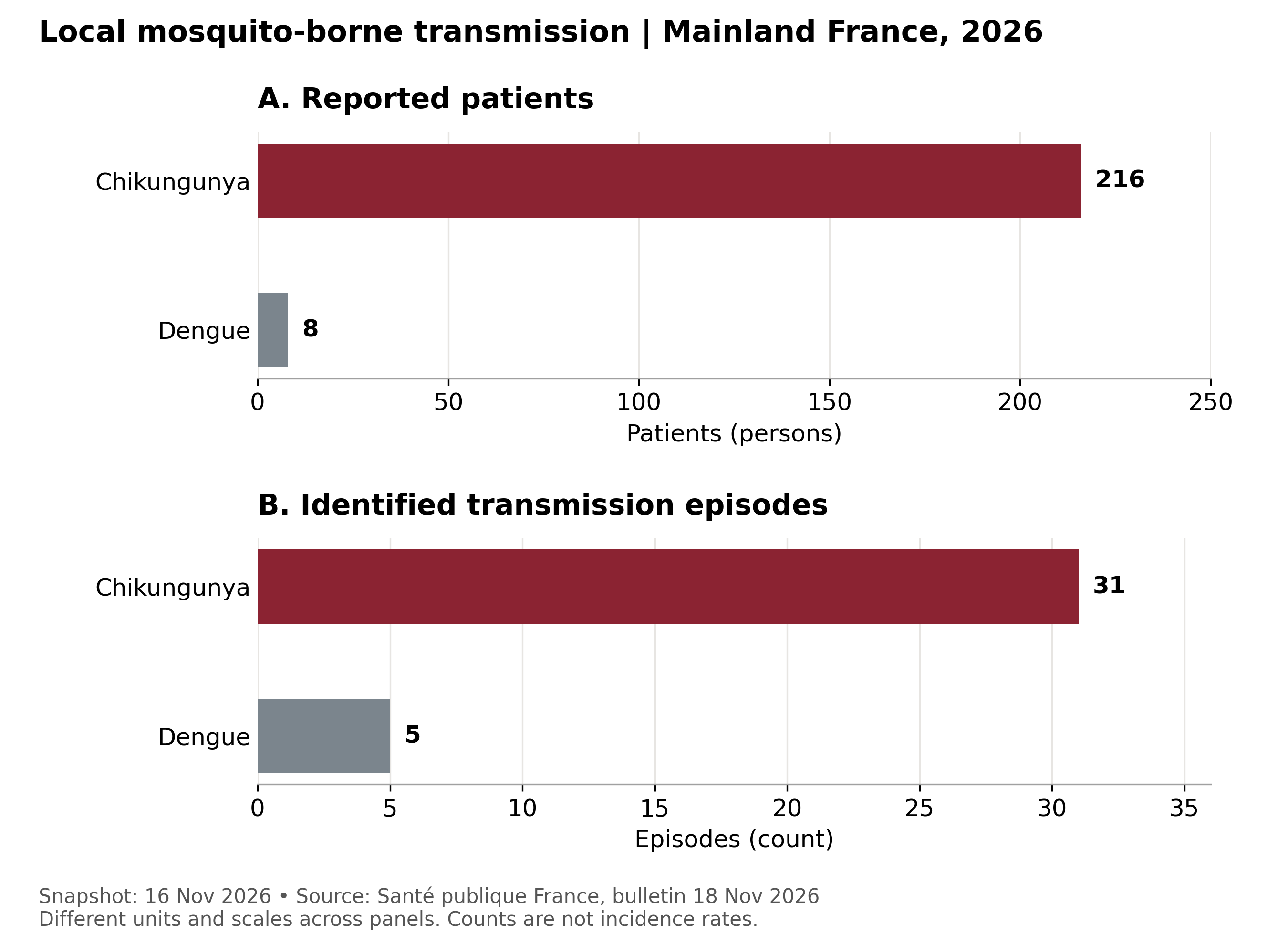
The quantitative analysis uses a single snapshot published by Santé publique France. Its scope is identified local mosquito-borne transmission in mainland France during 2026, with a cutoff of 16 November. There are two observational units: patients, counted as people, and episodes, counted as transmission groupings. Chikungunya accounts for 216 patients and 31 episodes; dengue for eight patients and five episodes. Together these give 224 patients and 36 episodes. The source's episode classification was retained; episodes were not treated as independent observations of individual patients.[4]
Calculations were limited to totals and simple proportions from the four transcribed values. Chikungunya represents 96.4% of patients, calculated as 216 divided by 224, and 86.1% of episodes, calculated as 31 divided by 36. These are not competing answers to the same question. One describes which disease the reported patients had; the other describes how reported transmission episodes were classified. Their difference is not evidence of an error. It demonstrates that changing the denominator changes the subject being described.
The arithmetic mean number of patients per episode is approximately 7.0 for chikungunya and 1.6 for dengue. Calling seven the typical episode size would nevertheless be difficult to justify: the simple table does not provide the full distribution across episodes. A few large episodes could raise the mean, or sizes might be more similar across episodes. Distinguishing these possibilities requires episode-level counts. A mean alone cannot reconstruct a median or variance, and it does not identify the most frequent episode size.
Figure 1 separates patients and episodes into two panels, each with an axis beginning at zero. Their units differ, so bar lengths should not be compared directly across the panels. A transcription table below the figure lets readers inspect the starting values. The purpose is neither to rank countries nor to assess the relative transmissibility of the two viruses. It is to show that a measure of patient burden and a measure of the number of investigation targets answer different operational questions.
The aggregate does not provide the total exposed population, the number tested or the number of undiagnosed infections. Nor does it provide age-specific severity, length of hospital stay or visits by institution. Accordingly, no incidence rate, test positivity rate, hospitalization risk or case-fatality ratio was calculated. An unavailable field is missing information, not zero. No population-adjusted comparison between Korea and France was attempted. Making a formula more complicated cannot make an analysis more precise when its denominator is absent.
Official counts do not establish that every case had the same probability of detection. Access to care, testing practices and heightened attention after a local alert may affect the observed numbers. The data are valuable as a record of what a public health agency had identified at that time. They are not experimental observations guaranteeing a uniform ascertainment process. Larger reported patient numbers can signal response needs, but cannot alone establish a biological difference in transmissibility. This analysis therefore includes no statistical significance test between the diseases.
The analysis also avoids estimating growth from a single snapshot. Placing an earlier bulletin or another agency's figure alongside it can readily produce a percentage change, but cutoffs, retrospective corrections and case classifications must be compatible for that change to be meaningful. Here, the analysis stays with one clearly defined snapshot. Assessing trends later would require a consistent series from the same agency together with its revision history. Without separating new illness from delayed registration of earlier cases, better surveillance can be mistaken for a sudden worsening of transmission.
| Disease | Patients (persons) | Episodes (count) | Patients per episode |
|---|---|---|---|
| Chikungunya | 216 | 31 | 7.0 |
| Dengue | 8 | 5 | 1.6 |
| Total | 224 | 36 | — |
Faster reporting after detection—and the gap before it
A 2023 study by Manica and colleagues examined reporting delays during the 2017 chikungunya outbreak in Lazio, Italy. The median interval from symptom onset to public health notification was 15.5 days overall, 33 days among patients whose symptoms began before outbreak detection, and eight days among those with onset afterward.[6] This is an observed improvement in reporting after detection. It was not a randomized experiment, cannot isolate the causal effect of an alert, and does not establish an acceptable reporting deadline for Korea. The findings come from an earlier event in a different health system.
An essential issue in interpreting this study is where the clock starts, rather than the processing speed of an average hospital. The onset-to-notification interval includes time before the patient seeks care. It is not the same as the interval from hospital arrival to a test result. Confusing them can misattribute difficulties in daily life or access to care to laboratory processing. Measuring only laboratory turnaround can, conversely, miss a long period of undetected illness in the community. The start and end points should be defined according to the process one intends to improve.
An analysis restricted to reported cases cannot observe delays among people who were never detected. Retrospectively recalled onset dates may also be imprecise. The study discusses such limitations and presents sensitivity analyses.[6] Its results can help identify weaknesses in surveillance, but cannot be converted into a promise that a particular training exercise will reduce cases by a specified percentage. Whether an operational improvement is sensible and how large its effect will be require separate evaluation. Faster reporting is not automatically fast enough.
Hospitals can draw specific operational questions from this work. How often is symptom onset missing? Is the point at which a clinician records suspicion documented? Can the time a result is reviewed be distinguished from the time it is communicated to public health? Choosing an improvement requires knowing which interval is longest and most variable. Additional laboratory equipment may help in some circumstances. If an available result is not reaching the responsible person, however, expanding equipment alone is unlikely to resolve the problem.
Additional documentation also has a cost. Requiring clinicians to re-enter the same date into several systems can reduce accuracy and take time from care. A practical proposal is to distinguish fields recoverable from existing records from information that must be elicited anew. Before making entry mandatory, a small sample can reveal where information actually goes missing. Institutions should be able to explain which decision an item will change rather than collecting it simply because collection is possible.
Roles for emergency departments and ambulance services
The emergency care system does not need to diagnose every rare infection at the scene. It needs to assess urgent illness, connect patients to appropriate care, and preserve the exposure and timing information required by the next service. A new infectious disease alert should not lead ambulance teams to delay acuity assessment with a burdensome interview. A realistic starting point is to agree on information for handover that fits official local alerts and existing transport protocols, then verify that the receiving hospital actually obtains it.
Recording only “no travel history” differs from recording “international travel not established; symptom onset unknown.” The former may be read as a completed assessment; the latter communicates remaining uncertainty. Patients may be unable to answer, and accompanying relatives may not know. Converting an unconfirmed history into an absence can narrow subsequent decisions incorrectly. Efforts to obtain better information should coexist with accurate documentation of what remains unknown.
For emergency departments, this column proposes a pathway linking laboratory staff, infection prevention personnel and the appropriate public health contact when a suspected case requires discussion. A list of personal names may fail during leave or overnight; roles and backup routes are more robust organizing principles. Attempted contact should also be distinguished from confirmed receipt of information. This is an operational approach to be tested locally. It does not replace statutory notification deadlines or national disease-specific guidance.
The explanation given to patients deserves equal preparation. Additional testing may be interpreted as a confirmed infection, while contact with public health authorities may feel like an accusation. Clinicians should separate what has been established from what remains to be investigated. Questions about travel or residence should be explained as efforts to identify possible exposure, not assign blame. A clear purpose makes it easier for patients and relatives to contribute relevant recollections.
Surveillance outside hospitals requires spatial information different from a clinical record. A home address is an important clue, but does not prove infection occurred at home. Workplaces, schools, care settings and frequently visited outdoor locations may become relevant. This does not justify making every movement public. Detailed information needed for an investigation and general information provided to residents serve different purposes. The minimum necessary detail should reach authorized staff, while disclosure to the public requires a separate assessment.
Care needs beyond the case count
Chikungunya may involve persistent joint symptoms as well as acute fever. CDC's travel medicine guidance identifies infants, older adults and people with underlying conditions as groups requiring attention to severe disease risk, and discusses prolonged joint pain.[7] This does not imply that every patient reported today will follow the same course. The available case counts cannot determine how many rehabilitation services or outpatient appointments will be needed. Maintaining continuity for patients who need longer-term care should be treated as a separate operational task.
Institutions can distinguish completion of acute care from recovery of daily function. Discharge should not automatically imply readiness to work, provide care or travel independently. Existing outpatient and community services could be connected so that patients with continuing functional difficulties know where to seek assessment. This column does not recommend a particular rehabilitation treatment or follow-up interval. It proposes clarifying responsibility and procedures for assessing support needs; individual treatment decisions belong in clinical care.
People with limited mobility or a need for interpretation may receive instructions for further testing or return visits yet be unable to act on them. Recording successful telephone contact as completed follow-up can therefore miss barriers to access. A pathway can include checking understanding and whether assistance with booking or travel is needed. This does not label an infection as a problem of a particular population. It recognizes that the same instruction can impose different burdens and makes those differences part of operational evaluation.
Considering vulnerable groups is not synonymous with collecting more personal data. Institutions should identify support needs while avoiding excessively small subgroups in public statistics. Where cases are rare, combinations of age, neighborhood and occupation may make individuals identifiable. Internal work can connect people to specific support while external reporting reduces identification risks. Transparency rests on explaining the basis of decisions and remaining uncertainty, not on disclosing every personal detail.
Conditions for connecting mosquito and clinical surveillance
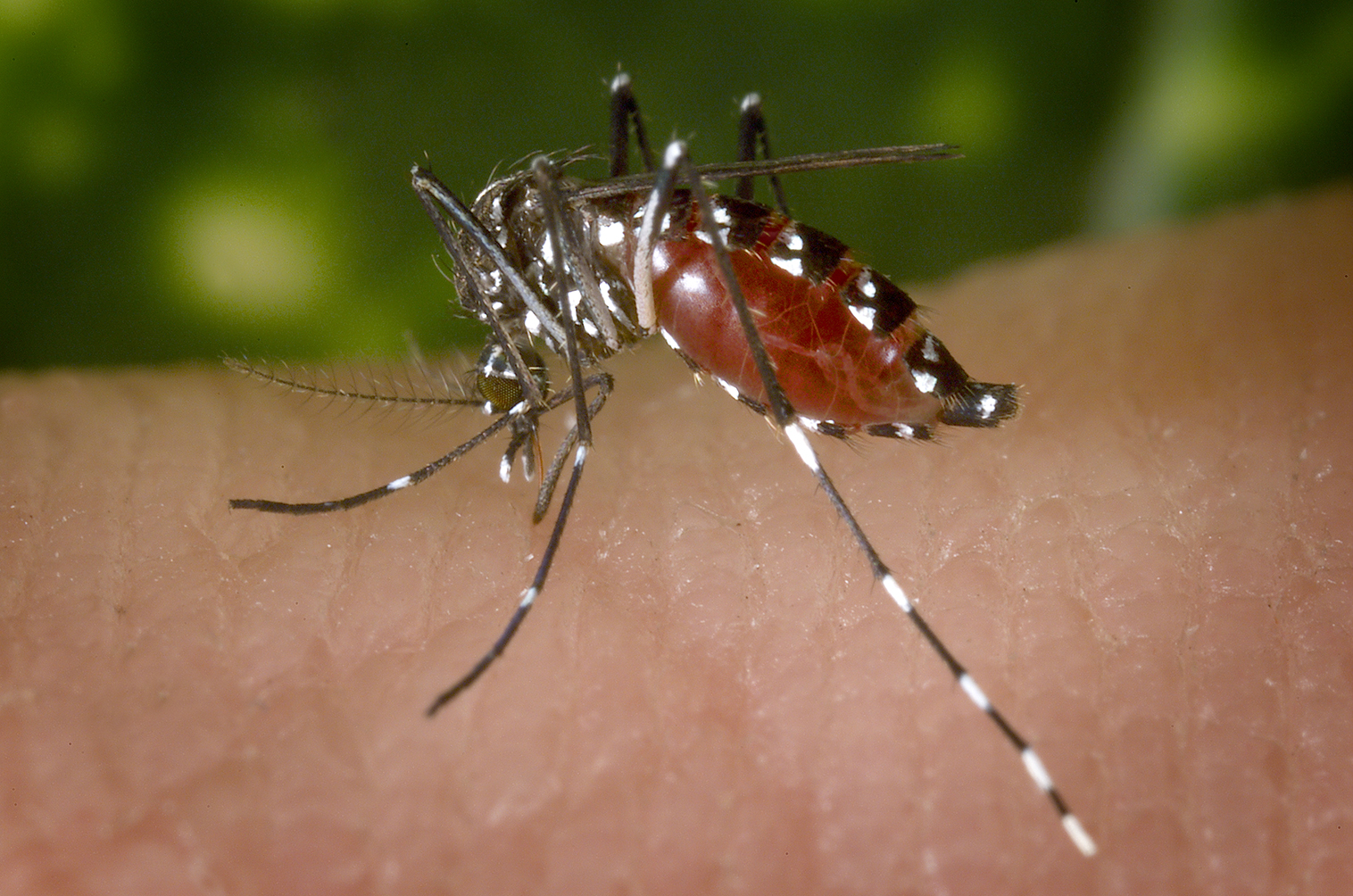
WHO describes reducing mosquito bites and managing breeding sites as approaches to chikungunya prevention. The principal vectors are active during the day as well, and use water-holding containers for breeding.[8] Local planning should therefore question whether advice based solely on nighttime mosquito activity is sufficient. Decisions about where, how and how extensively to apply vector control require field information and professional assessment. The photograph in this article illustrates the mosquito; it is not evidence of its detection at a particular Korean location.
Connecting clinical and mosquito surveillance involves more than placing two datasets on one map. Patient data and trapping data may cover different time intervals, and trap locations may not represent where residents were exposed. Hospitals and environmental investigation teams should first explain what each dataset observed. A site where no mosquitoes were caught must also be distinguished from a site that was not surveyed. The extent of observation should be shown so that an empty map is not mistaken for a map of no risk.
Failure to detect a pathogen in the environment has a conditional meaning. The conclusions depend on when, where and how extensively the investigation was conducted. When clinical findings and environmental results differ, it is reasonable to examine whether they describe different times or places rather than automatically discarding either. This does not render all negative findings meaningless. Repeated negatives from an appropriate investigation may inform assessment; understanding their value requires understanding the survey design.
Application to Korea begins with actual local conditions. Foreign temperatures or mosquito densities cannot simply be inserted into a Korean assessment, and seasons and environments differ within countries too. The material reviewed here does not establish local chikungunya transmission in Korea. Institutions should adjust preparedness using current guidance and surveillance information from their public health authorities. Acknowledging low risk is compatible with maintaining contact pathways and laboratory referral procedures. Response intensity need not remain identical throughout the year.
Taking the objection of over-alerting seriously
Efforts to avoid missing rare infections can be misunderstood as a call for ever more tests and alerts. Applying the same tests to every common symptom, however, can divert limited staff and laboratory resources from other patients. Positive results also become more difficult to interpret when the prior probability of infection is low. The proposal here is to preserve a route for reassessment, rather than indiscriminately expand testing. Local experts should define when additional review is warranted and evaluate whether those conditions produce an excessive workload in practice.
More notifications after an alert are not sufficient evidence of success. They may reflect better case detection, but unnecessary inquiries may also have increased. This column therefore proposes examining review outcomes, staff workload and time to a response alongside notification numbers. A surveillance system should not be judged good only when every alert becomes an outbreak. A well-reasoned investigation that excludes a concern is valuable too. If reaching that conclusion consumes disproportionate resources, the process still needs adjustment.
The opposite approach—avoiding any communication until confirmation is available to conserve resources—creates another problem. Delayed information also delays public health authorities' opportunity to decide whether further investigation is warranted. Distinguishing consultation about a suspected case from a public announcement of a confirmed case can ease this tension. Internal communication can include uncertainty and testing status, while public statements separate established facts from ongoing investigation. The threshold for beginning a professional discussion need not be identical to the threshold for warning residents.
Evaluation should also consider seasonal change as an alternative explanation. If cases decline after a response during a period of falling mosquito activity, the entire decline cannot be attributed to vector control or education. Changes in clinical suspicion and testing volume can also alter observed counts. Evaluating effects requires examining the comparability of conditions and observation methods across periods. Early on, when data are limited, checking whether procedures worked and essential information arrived is more defensible than estimating a causal effect.
A hypothetical example: a telephone call is not the endpoint
The following is hypothetical, not a description of an actual event. Suppose a patient without international travel presents to a regional emergency department with fever and joint pain, and the clinician judges that local surveillance conditions warrant further review. Closing the relevant history at registration because travel is absent would leave little information to support that judgment. Requiring every visitor to complete a lengthy epidemiological questionnaire would, conversely, disrupt care. An institution could test recording essential dates and exposure information initially, followed by detailed review when clinically indicated.
Suppose, in the same scenario, a specimen is sent to an external institution. If responsibility becomes unclear between referral and result return, information may be lost after the patient leaves. The hospital can designate the role that reviews results, its backup during absence, and routes for informing the patient and public health authorities. Evaluation should ask whether necessary information reached its recipient, rather than count telephone calls. It should also check whether the next action is recorded when contact fails.
Records should remain when a negative result leads to a decision that further investigation is unnecessary. Understanding why review ended helps clinicians use earlier decisions appropriately if a similar patient returns. Equally, the possibility of later revision cannot justify following every patient indefinitely. Closure criteria should be paired with conditions for reopening review. Recognizing uncertainty means making decisions on current evidence that can be revised, rather than postponing every decision without limit.
Preparedness that can actually be evaluated
A reasonable first hospital exercise is a small review of existing infectious disease referral records. Distinguish symptom onset, first consultation, recorded suspicion, specimen collection, result review and communication to the required institution. Missing dates should be counted as missing rather than silently removed from calculations. The selection criteria for reviewed cases should also be retained. Only then can an apparent reduction in delay be assessed against the possibility that records with incomplete information were simply excluded.
Indicators become meaningful when their denominators are explicit. Onset-date completeness, for example, can be defined as the proportion of reviewed records containing an established onset date. Communication completion can be defined as the proportion of cases requiring information transfer that have documented receipt. These measure completeness of work processes, not infection risk or treatment effectiveness. Institutions using different selection criteria should avoid simple league tables; initially, the measures are better suited to assessing improvement within the same institution.
Time indicators can combine a median with review of the reasons for particularly long intervals. An overall improvement does not demonstrate equitable progress if contact repeatedly fails for some patients. A single very long interval should not immediately become an individual staff performance score. Patient availability, holidays and external laboratory operating arrangements may all contribute. Numbers should be starting points for identifying processes to improve, rather than instruments for assigning responsibility without investigation.
Joint ambulance–hospital exercises may gain more from testing information handover than from asking participants to name a suspected disease. Did unknown information remain unknown rather than become “absent”? Could the receiving hospital locate what it needed? Did the contact route work overnight? Exercise results do not guarantee success during a real outbreak. They can nevertheless reveal where information disappears and permit correction before the next exercise. Even small changes to record forms should be tested in practice before wider adoption.
Local public health agencies should design their capacity to answer questions alongside their alerts to institutions. Rather than relying on a long disease description, an advisory can clearly state what is currently known, which cases warrant discussion and which contact point is available. When circumstances change, it should also clarify whether earlier advice remains valid. Simultaneous circulation of old and new instructions can generate inconsistent decisions for the same patient. A document's date and scope are information needed for judgment, not administrative decoration.
Today's developments do not justify treating every fever or episode of diarrhea as a new outbreak. They support a system that can reopen its assessment when a patient's illness does not fit the expected route, while maintaining clinical care. No travel history, one negative result and a small case count are each useful pieces of information, but none answers every question alone. When hospitals, ambulance services, laboratories and public health authorities communicate the conditions attached to those observations, preparedness can protect against both missed signals and unnecessary alerts.
References
- [1] 질병관리청 / KDCA. 국내발생 추정 콜레라 환자 10년 만에 발생, 예방수칙 준수 당부. 2026-11-20. 대한민국 정책브리핑에 제공된 질병관리청 원문 / KDCA release reproduced by Korea Policy Briefing.
- [2] World Health Organization. Chikungunya virus disease – Switzerland. Disease Outbreak News. 2026-11-17.
- [3] Swiss Federal Office of Public Health. Chikungunya. Current official information, including first local cases in 2026.
- [4] Santé publique France. Chikungunya, dengue, Zika et West Nile en France hexagonale. Bulletin de la surveillance renforcée du 18 novembre 2026.
- [5] Centers for Disease Control and Prevention. Clinical Testing and Diagnosis for Chikungunya Virus Disease. 2026-10-21.
- [6] Manica M, Marini G, Solimini A, et al. Reporting delays of chikungunya cases during the 2017 outbreak in Lazio region, Italy. PLoS Negl Trop Dis. 2023;17(9):e0011610. DOI: 10.1371/journal.pntd.0011610. PMID: 37708121.
- [7] Staples JE, Hills SL, Powers AM. Chikungunya. CDC Yellow Book: Health Information for International Travel, 2026 edition. Web chapter dated 2026-01-29.
- [8] World Health Organization. Chikungunya. Fact sheet. 2025-04-14.
Korean cholera news and Swiss and French chikungunya updates frame an analysis of test timing, reporting delays and information handover across emergency care and public health.
SCH-COLUMN-2026-11-20,EN,LOCAL-TRANSMISSION